

Rule In Hell
darkness is not a void—but a womb from which your fuller life may emerge

Have you been thwarted, fired, or humiliated? I have.
I know the way out, at least for a determined few. -M- x
As a child, adolescent, and into adulthood, I often felt ill at ease, locked out of the mainstream, and uncomfortable, literally, in my own skin.
I had to create a world where I could experience power and ability—on my private terms.
In pursuit of selfhood—by which I mean self-expression—I suffered numerous failures and setbacks. Some were intensely painful. All produced refinement.
No one wishes to suffer. But—nothing of worth arises from ease. In darkness, we stumble. We are also born.
I abide the principle of ruling in Hell—of making a personal stand amid loss. It has burnished and redeemed me as a writer, seeker, husband, and parent.
It may do the same for you.
Professionally, my three-plus decades as a writer and publisher make my case.
I have labored at prestigious places and low-rent ones. I have been feted. I have been fired.
Loss has led me to victory—the defining fruit of which is: expressive freedom.
Wherever I experienced the liberty—or neglect—to most fully chart my path, I was not only happiest but also most artistically successful and financially stable. The latter cannot depend on the former. But when they meet, take note.
Personally, I have found it easier to function in a dynamic and self-directed fashion in stations outside mainstream respectability.
Peers have sometimes wondered at my choices—or, if I am being plain, at my accidents recast into choices.
I stand on the words of John Milton’s (1608–1674) Satan from Paradise Lost:
Here we may reign secure, and in my choice
To reign is worth ambition though in Hell:
Better to reign in Hell, then serve in Heav’n.
I will return to my account—filled with failures-cum-victories. I first consider the career of an artistic hero who exemplifies the metamorphic process I describe. He would wince at being called a hero. It makes him one all the more.
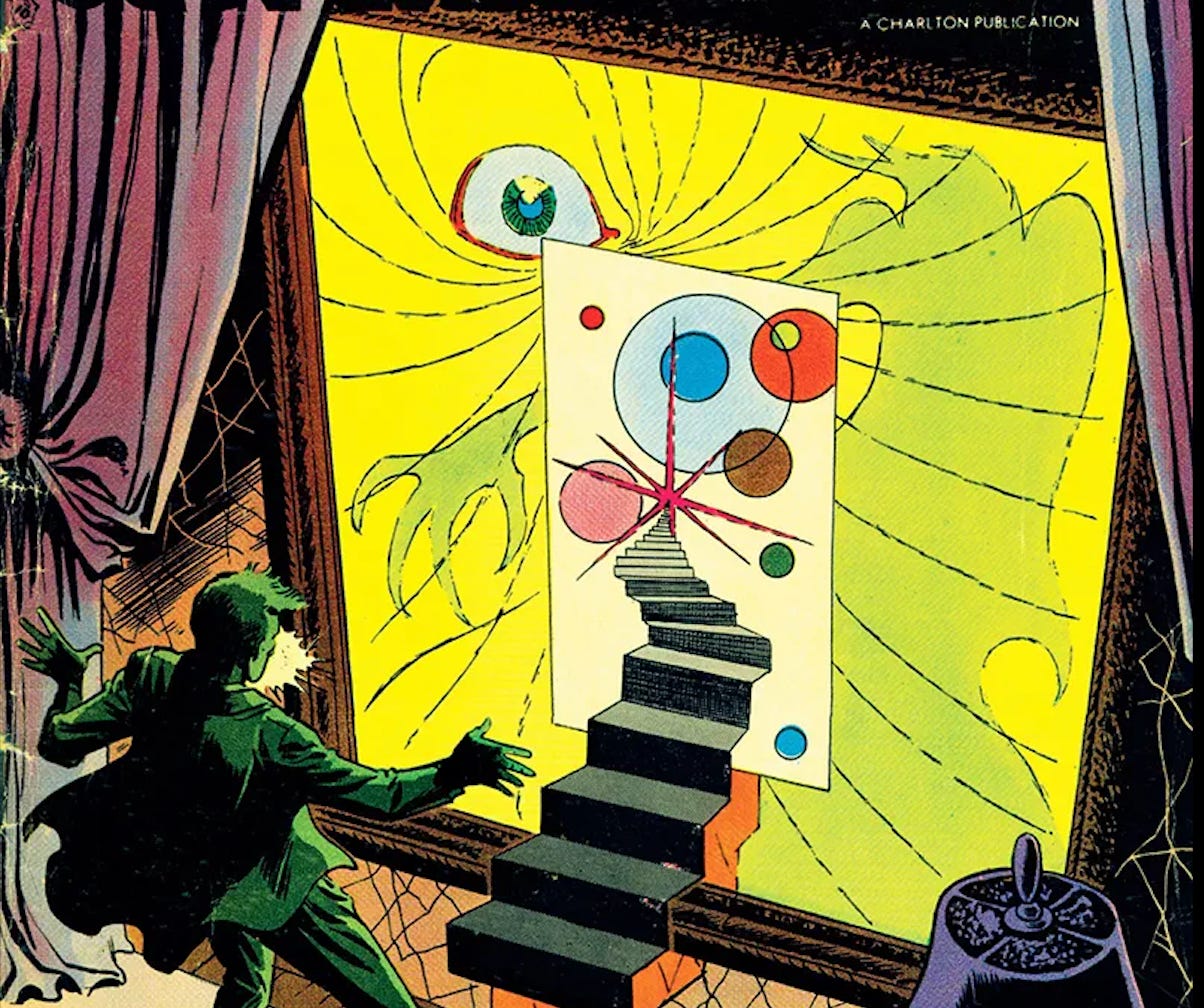
I refer to comic illustrator Steve Ditko (1921–2018), one of my favorite artists whose work appears atop this article.
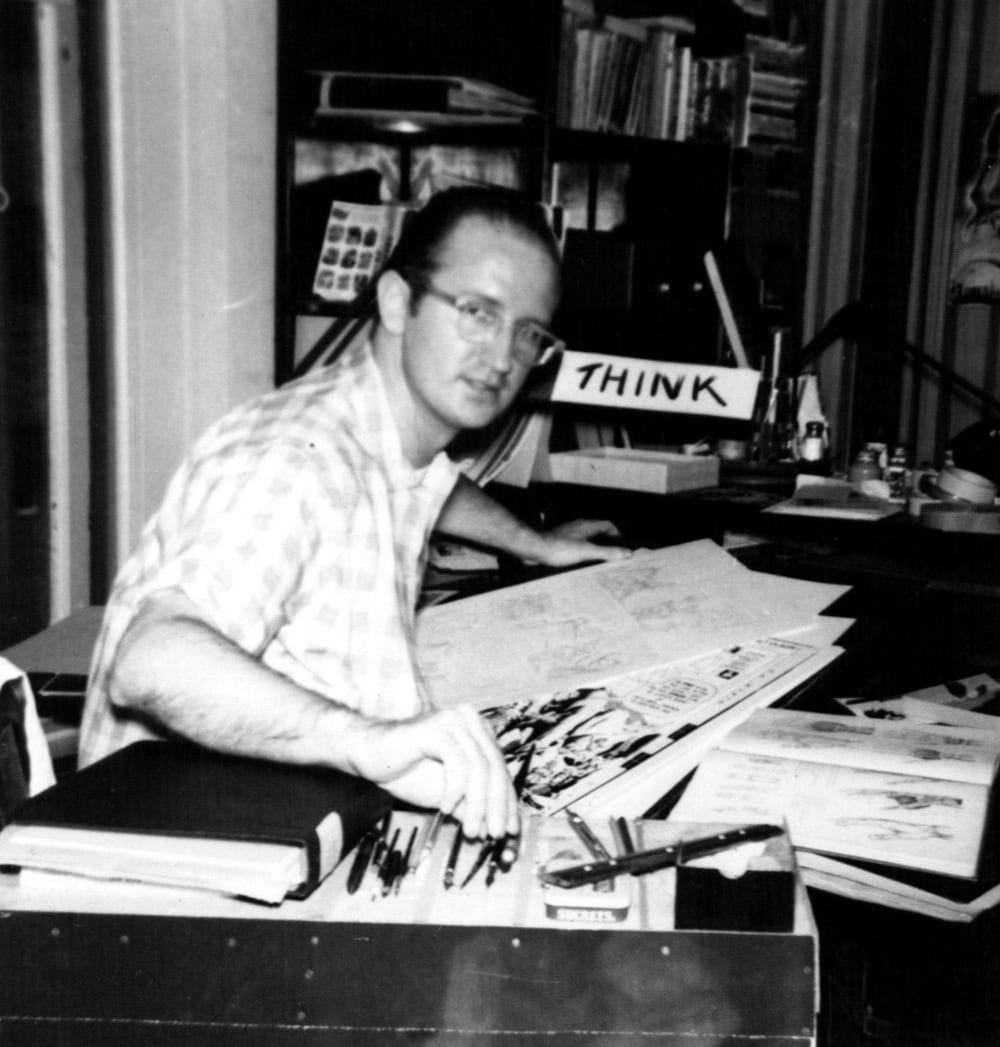
Steve is best known as the co-creator, with Stan Lee, of Spider-Man and Doctor Strange. Today, Steve’s mid-century work—mostly in sci-fi, horror, and his unusual brand of Objectivist-themed comics—attracts serious critical and cultural attention.
It is a plot twist as unexpected as any from his stories.
An ardent disciple of radical capitalist Ayn Rand (1905-1982), Steve cultivated a strict ethos of self-direction. Rand is constantly—and excessively—pilloried. She was a self-created persona, in my eyes the protean parallel to another Russian mage: Madame H.P. Blavatsky (1831-1891). Rand’s self-conception is perhaps her greatest work.

A determinedly private man, Steve rarely granted interviews. I was refused. He wished to be understood solely through his work.
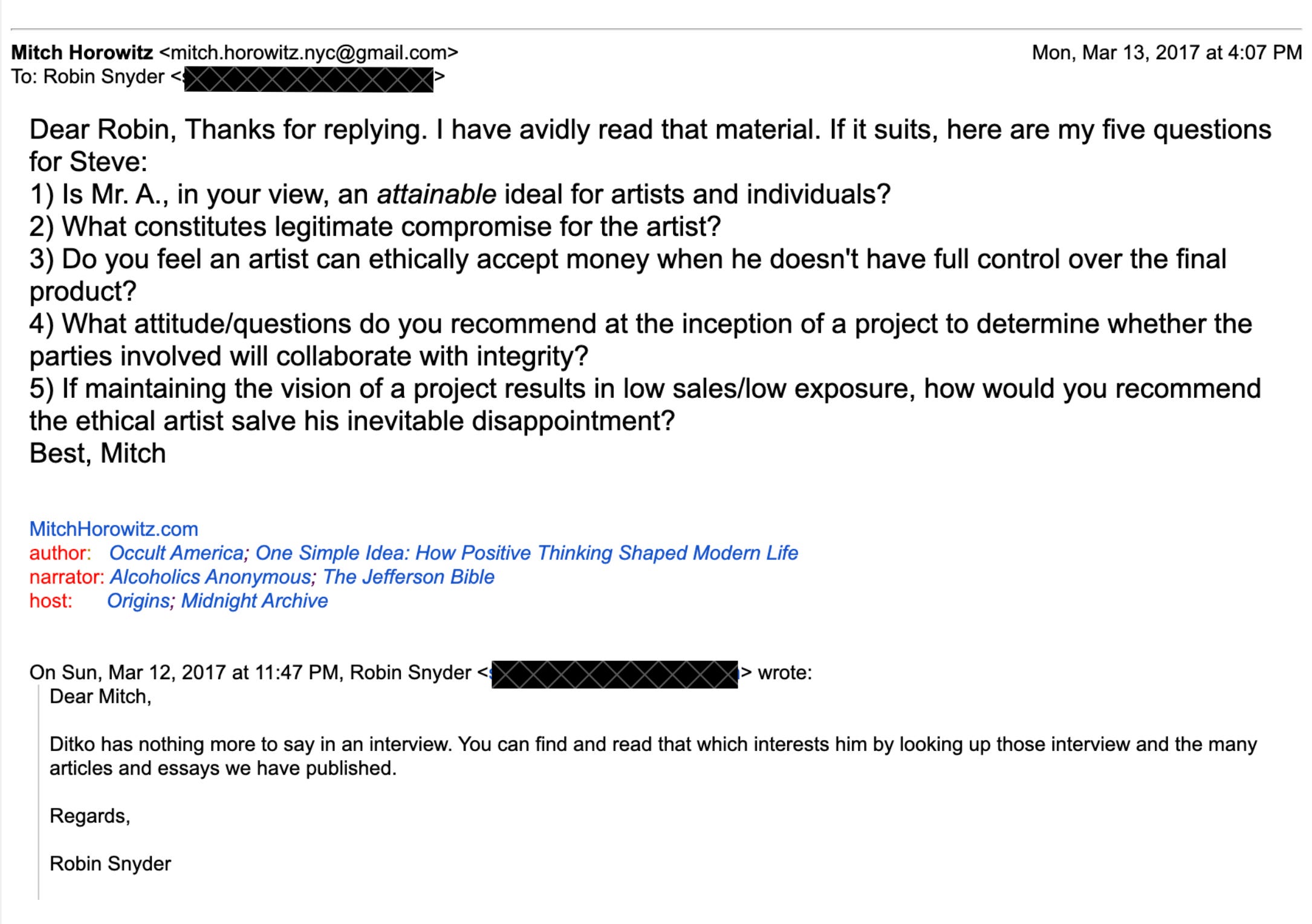
Steve was so dedicated to his conception of artistic integrity, a topic on which Rand wrote eloquently, that he was said to reject money from moviemakers of his characters, refusing sums in connection with studio vehicles of Spider-Man and Doctor Strange.
Due to artists’ work-for-hire status at Marvel and other comic publishers in his era, Steve and fellow creators held no rights to their creations; the studio offers were gratuities.
Steve’s reason was simple. He disliked the screen adaptations. As a publishing executive, I had an expression: “Don’t be a hero after you cash the check.” Steve did neither.
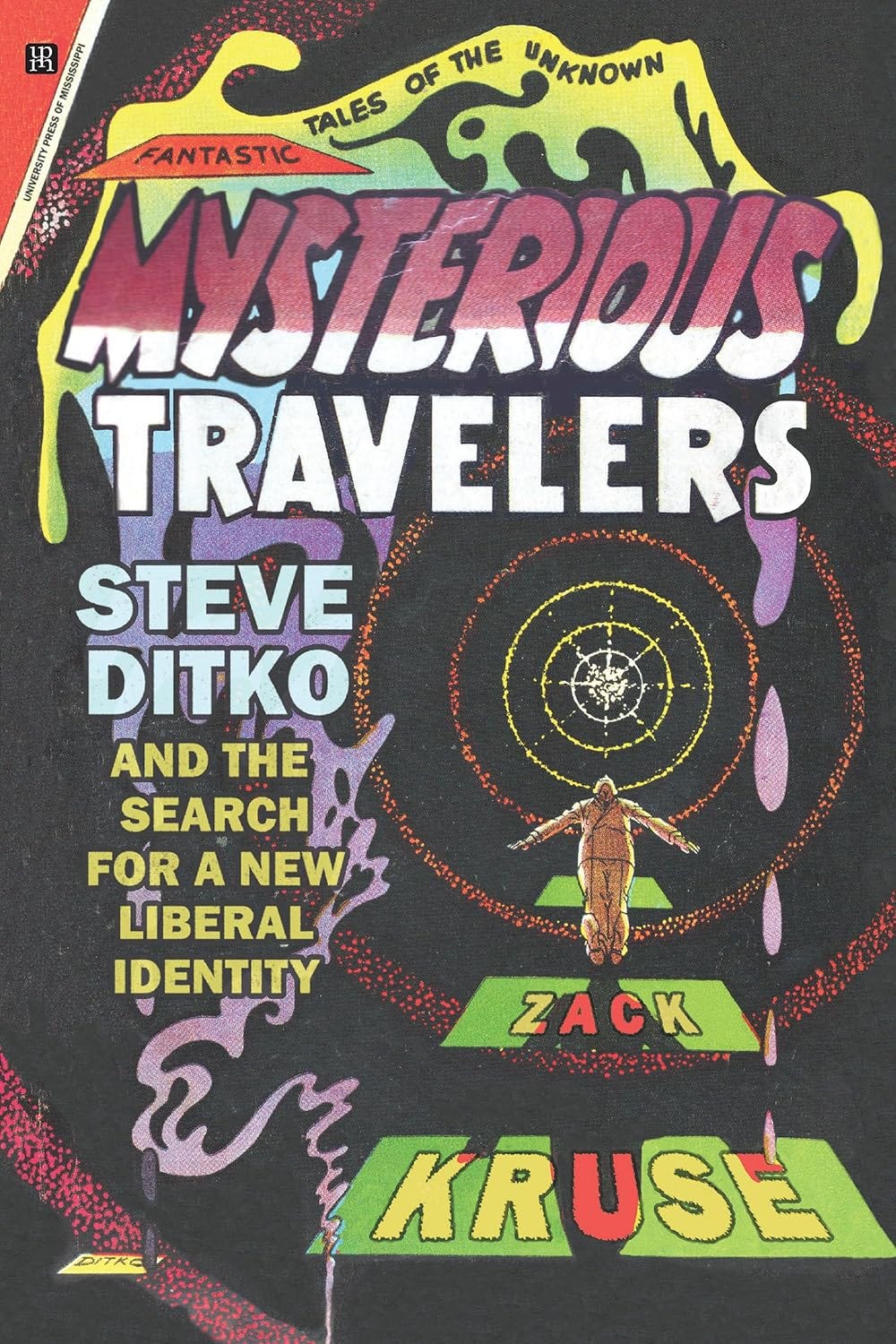
This illustrator who worked for decades in the same cramped Times Square studio, and whose work often appeared on quickly yellowing, acidic paper—comics were then considered disposable—is today a legend. His work hangs in galleries and forms the topic of retrospectives, essays, and books. Among the most compelling is culture critic Zack Kruse’s Mysterious Travelers (University Press of Mississippi, 2021).
This is all the more surprising because comic fans in the 1970s and 80s—me among them—considered Steve a relic whose stiff figures and sketchy drawings (he was not doing his best work then) did not fit the realist bent of the day.
What changed?
Steve’s status as an icon arrived through rediscovery of his visionary and prolific visuals on once-obscure horror, supernatural, and sci-fi comic series of the 1950s and 60s.
In those genres, as much as his Marvel ones, Steve wielded his pencil the way Orson Welles did a camera: using extreme closeups, panoramic perspectives, cuts in time and space, combinative shots—things rarely seen in comics then. His depiction of cosmic, magickal, and other-dimensional landscapes remain peerless.
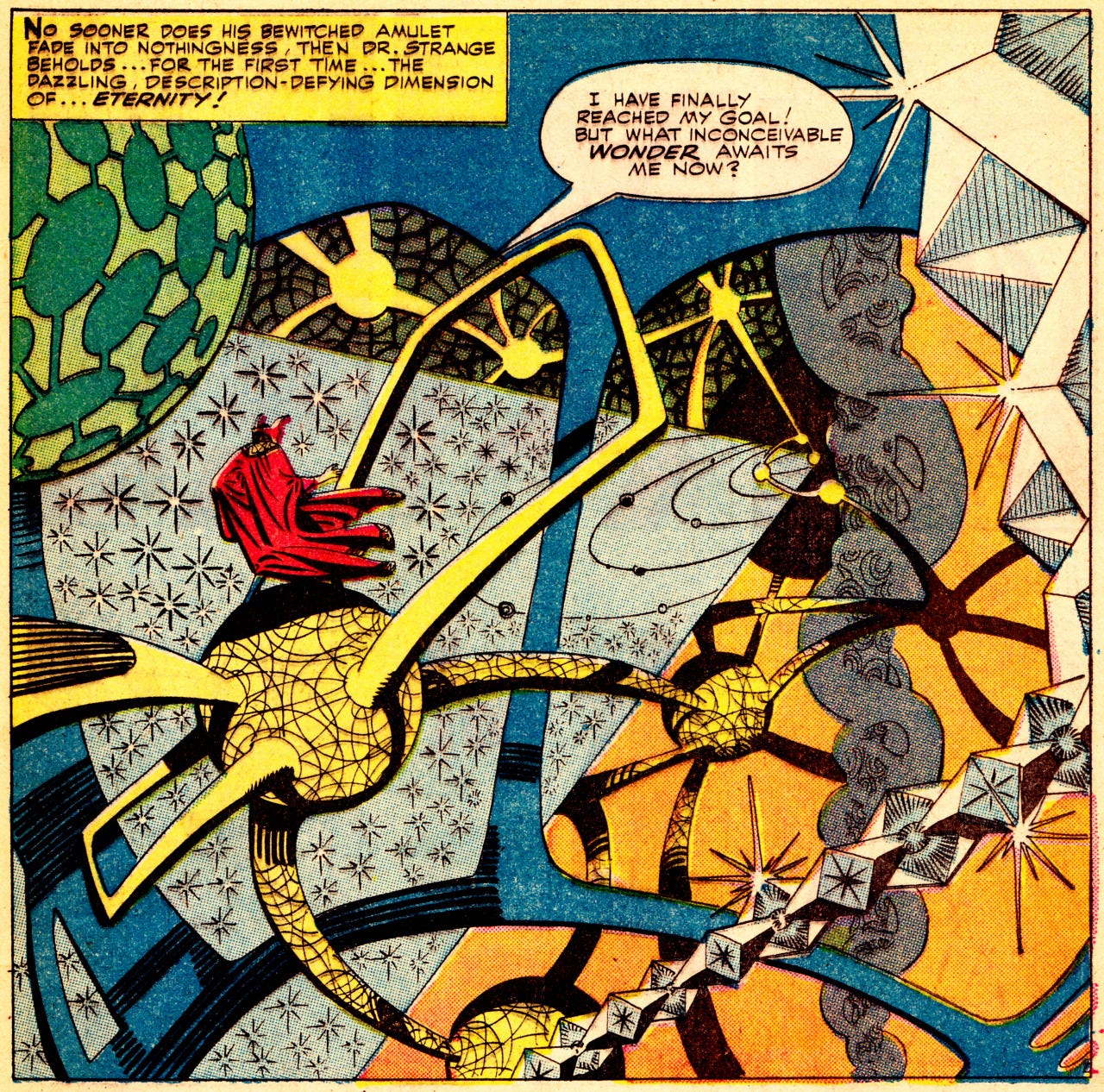
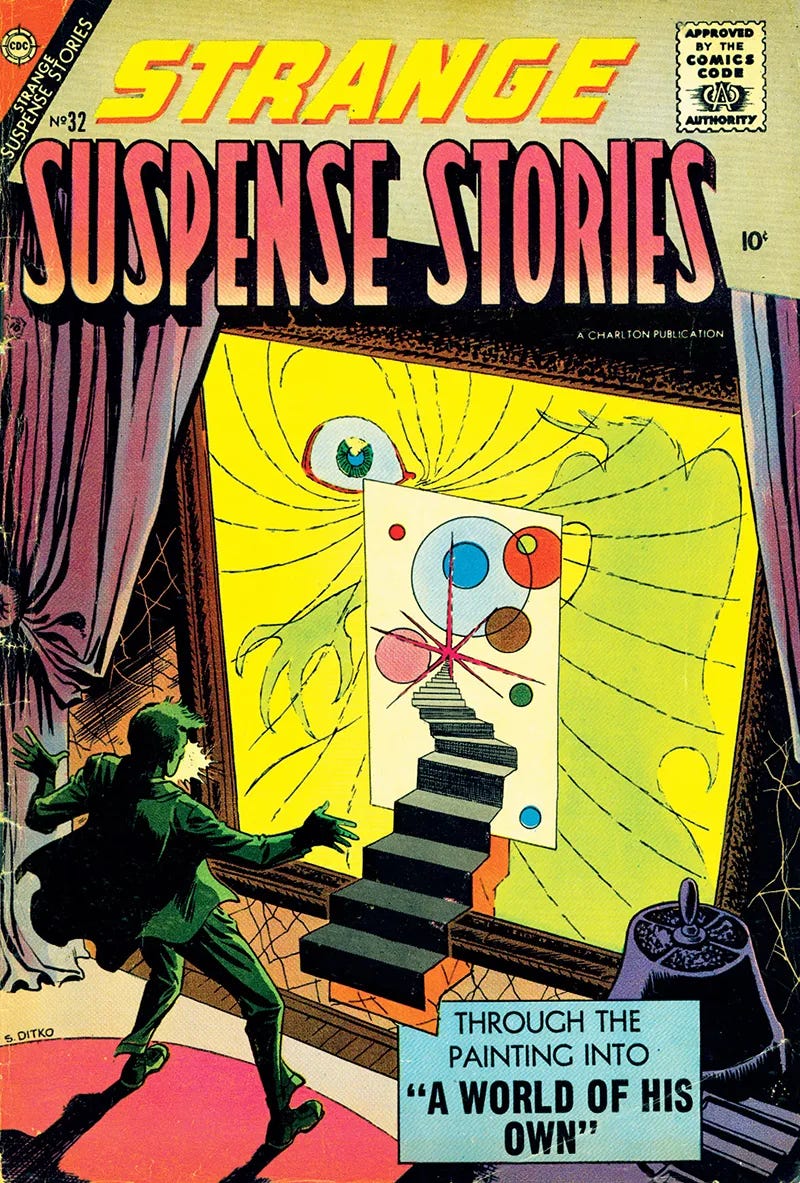
Here is the key thing: the auteur did his best work when left to his own devices. That is why his association with Stan Lee’s Marvel—the hottest shop in comics—proved short. As I see it, Steve ruled in Hell—at an out-of-the-way and somewhat disreputable house called Charlton, a Connecticut-based comics press.
Critic Douglas Walk put it this way in The New York Times on August 15, 2008:
Ditko drew his first comics as a professional in 1953, developing his haunted, alienated imagery in Z-grade horror and crime series. He quickly formed a longstanding affiliation with Charlton Comics, a Connecticut operation that published funnybooks to keep its presses running, paid the worst rates in the business and let artists draw more or less whatever they pleased.
Charlton was known not only for low pay but also poor-quality printing, knockoff titles, cheesy licensing adaptations, and short-lived series.
For Steve it was creative Valhalla. Because he was left alone.
The absence of editorial or quality standards—a mark of unprofessionalism elsewhere—was just what the icon needed. He thrived sans oversight, boundaries, or meddling. Where others may have sunk—or held their heads low—he excelled.
If you seek out published collections of Steve’s work, you will find that his most widely anthologized stories are from Charlton. They stand among the most innovative comics of the twentieth century.
Like Steve, I have always chosen freedom over prestige.
As a 25-year-old assistant editor, I was offered two jobs that would bump me to full editor: one was at Dell, a popular mass-market house, and the other was at Arcade, an intellectual press that had just published the final book by another of my heroes, social critic and activist Michael Harrington (1928-1989).
I chose Dell.
I believed—rightly as it happened—that I would find greater dynamism at a house where the range of topics was wide open.
At Dell I published the first paperback by iconic outdoors writer Jon Krakauer; a bestselling series of novels that formed the basis for the BBC/PBS miniseries Prime Suspect; the first widely acclaimed book on the “political correctness” controversy (a languid debate by today’s standards). And much else.
Prestige came knocking. While building my career as an acquisitions editor in the mid-1990s, I landed a “dream job” at a highly visible and now-defunct publishing house called The Free Press, which was then at the center of a hopeful but failed revolution in intellectual conservatism.
I worked with several highly regarded writers and nearly everything that we published got reviewed in opinion-shaping media like The New Yorker and The New York Times Book Review. It was an exciting period. It ended quickly.
Despite early successes, I had difficulty signing up good books, getting in with the right agents, and breaking through. Projects I coveted, like a book by Jesse Jackson opposing the death penalty, were internally blocked. For political reasons.
One June afternoon I returned to my office after lunch and found there were no phone messages waiting for me—a sign of morbidity.
I quietly closed my door and laid my head on my desk, knowing that sooner or later I was going to be fired. In under a year, I was.
Realizing that June day that the end was near, I knew I had to seek new work. In the months ahead I experienced a series of tantalizing “almosts”—but nothing ripened.
I was offered work at a glossy political magazine called George by its star founder John F. Kennedy, Jr., a true gentleman who tragically died in a plane crash soon after. One night an inebriated patrician editor offered me a job at a leading political and cultural magazine. His deputy later shot it down over a confrontational lunch. I made the final cut for an arts-and-ideas editor at The New York Times. They settled on someone with more journalistic experience.
It was unnerving and disorienting to come so close to the golden ring—yet never grasp it.
Realizing I could not go the white-collar route of relying on contacts and connections—none of which I was born with: mom was a medical secretary and dad was a Legal Aid attorney—I decided to go blue collar and began applying for openings like any novice.
I needed to work. I took the first job offered: a lateral position as a senior editor at a backwater New Age publisher then called Tarcher/Penguin. I immediately liked the publisher, we personally bonded, and, although spirituality was then secondary to me, I considered it someplace I could thrive.
Some of my friends and industry colleagues saw it differently. The house was considered low-rent, especially compared to where I had been. One New York publisher disinvited me to a film screening. “This is for industry reporters,” she said, “and they’re not gonna know you from Adam.” In New York, when you fall—you fall hard.
I did not care. I determined that it was better to honor an open door, better to work in a place whose raw clay I could mold—whether into golem or Rodin—versus hold out for a fancier job at a more elevated outlet.
I took a Ditko-esque attitude. Or, rather, I took the attitude of Milton’s unvanquished angel.
My gambit worked. I quickly grokked to the catalogue of mystical books on the imprint’s backlist—and began to discover philosophies, from New Thought to the ideas of spiritual teacher G.I. Gurdjieff (1866–1949), that made a profound difference in my life.


I recognized something: more than sixty percent of the gross operating profit came from the backlist. The place where the classics live. When you arrive in a new organization, determine where the money flows. Plant your flag there. Layoffs rarely occur where budgets thrive. I published many new books—by authors from David Lynch to Jacob Needleman—but I dedicated myself to breathing fresh life into the oldies, which most publishers neglect. Operating profits in publishing hover at 9 percent. Some of my projects earned 70 percent. You read that right.
The result? No one from my shop got laid off during the Great Recession of 2008, when the national book chain Border’s closed. Not one person lost salary or benefits. I am proud of that. Most of them think it came from fairy dust, if they think about it at all.
Just as important—perhaps more so—I was able to bring nearly unprecedented gravitas to a field where such refinement was achingly needed. New Age publishing has never been a fount of intellectual excellence—but why not? Why couldn’t you bring the same standards of seriousness to metaphysical literature as to any other kind? If matters are examined—truly examined—there exists no innate barrier. Not for me. I challenge skeptics (a noble title when earned) to read the article below and argue contrarily.

I fostered an environment where some of the best minds in occult, esoteric, and self-developmental literature could write seriously and be taken seriously. “You’re the only editor I’ve ever had,” Whitley Strieber told me, “who I didn’t suspect hung up the phone and started laughing about the UFO nut.”
Never.
This brings me to the most important development for me personally. I realized that I not only wanted to maintain a serious space for metaphysical thought, but I wanted to write on these topics myself. And I could. Glowingly, after much effort.

I soon had my own bylines in the same august publications that once reviewed the books I published, from the New York Times to the Washington Post. So, that arrived, too. But it arrived only after the rough opportunity to fashion a vessel of my own making. To rule in Hell.
My greatest accomplishment as a publisher was rediscovering myself as a writer. I found a sense of mission, purpose, and, ultimately, a true vocation. I have practiced it exclusively since I was fired—for the second and last time—in 2017 after a corporate takeover by Random House.
Had I initially taken the advice of ambitious friends, I would have held out for something better. I would have been wrong.
I began this article with a quote from Paradise Lost. I now quote from the Talmud on a related point.
In the tract Pirkei Avot, or Ethics of the Fathers, which is constructed largely as a Socratic dialogue between masters and students, a disciple asks: “What is the right path for a man to follow?”
His teacher replies, “Go to a place where there are no men, and there strive to be a man.” (2.6)
Go where you are needed. Where your presence proves transforming. Where you are tested by an absence of conventional support—and, with it, conventional barriers. Read that twice.
I sometimes prescribe an exercise called the 10-Day Miracle Challenge. It appears in my 2020 book The Miracle Habits. When I arrived at the title of both, I worried that they sounded corny or sensationalistic.
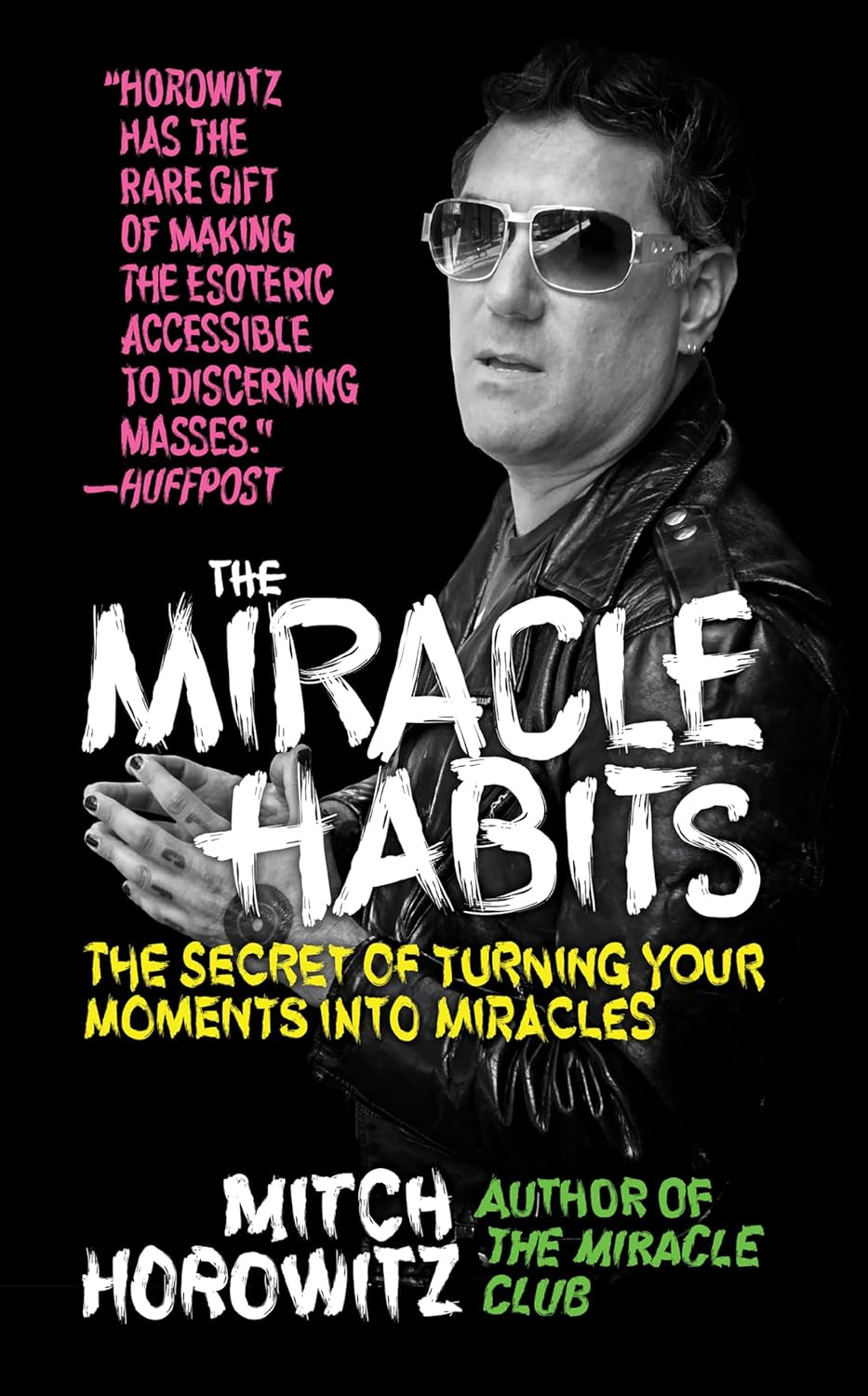
That said, I am public facing. I determined this in my Dell days. I believe in making bold promises—and supporting them.
I have discovered that ruling in Hell—going your own way without regard to respectability—produces surprising outcomes. In many ways, the best outcomes: because they arrive without compromise or guild mentality.
In February of 2020, my future wife and I got invited to a reception for the opening of a new exhibit at the Guggenheim Museum in New York City. The invitation came from one of the exhibit’s curators, whom I had met briefly before. A lot of hustling and jostling goes on at these events, so I was unsure whether to even approach him to say hello.
At the shoulder-to-shoulder reception he spotted me from across the room and his face lit up smiling. We worked our way over to say hello. He told me excitedly how he had been working with the 10-Day Miracle Challenge and he had experienced breakthrough results in the past two days.
This was not a setting where “miracle challenges” constituted cocktail-tinkling conversation. But there it was.
I had made no effort to be impressive or appealing in any literary manner in my choice of title or exercise. But to hell with it, I told myself—it’s what I believe.
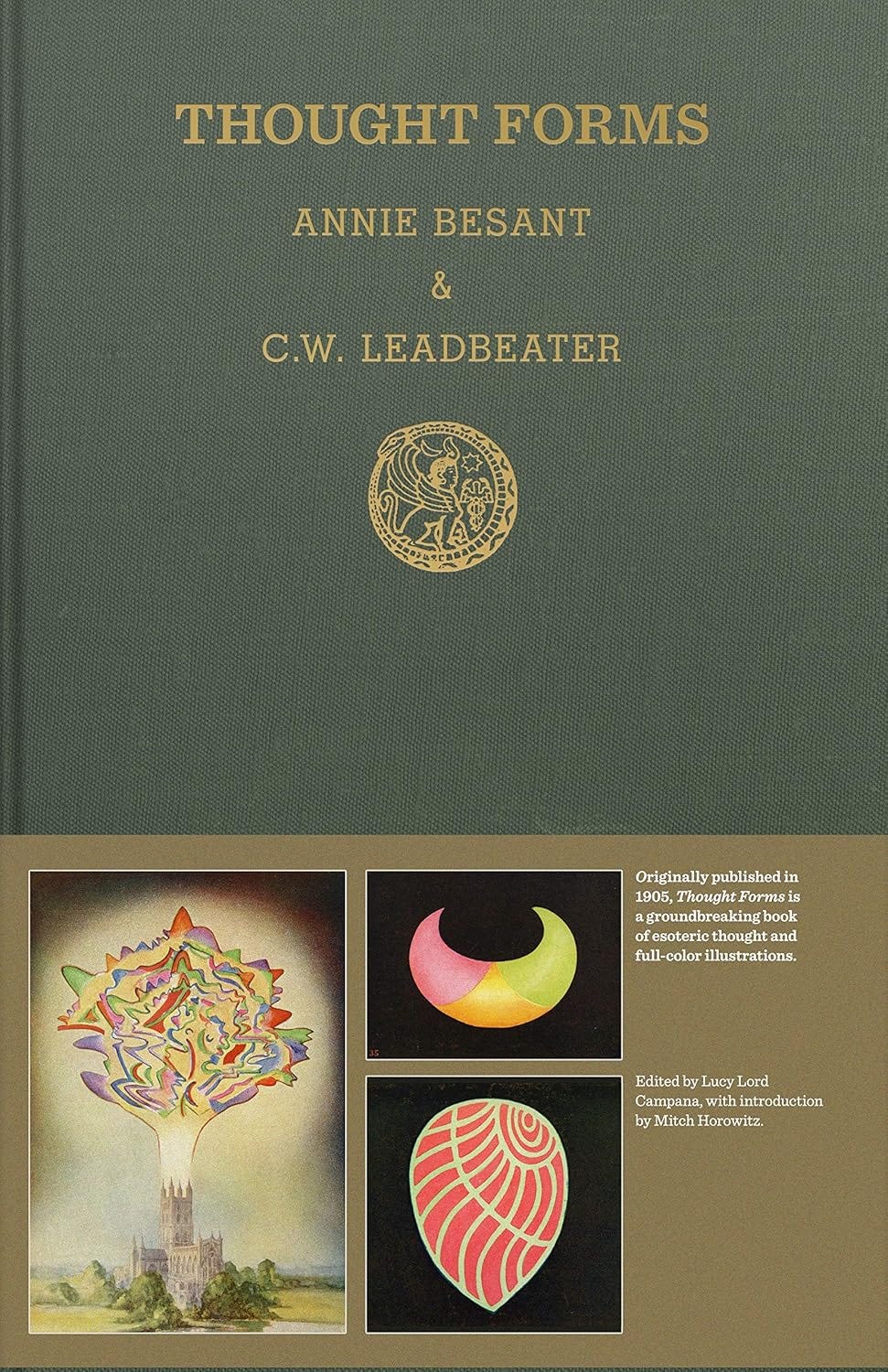
Soon after, he and I collaborated with editor Lucy Lord Campana and Sacred Bones on a truly beautiful reissue of the 1905 classic of clairvoyant perception Thought Forms by Theosophists Annie Besant and Charles Leadbeater.
Here we may reign secure, and in my choice.
Follow your choice. Or, put differently, accept and do not flee from defining, if temporarily painful, reversals. Like winter soil, they conceal seeds of something better. But only if you believe in and cultivate those seeds rather than abandon them.
Earlier I used the term miracle. In my definition, a miracle is a fortuitous departure from all conventional expectation.
Miracles flee artifice. They follow exposure and effort. You may find them in what some people—and maybe you—deem Hell.
Is a strange and unbidden door before you? Does it open to uncertain places?
Take it.
I loved this. It’s exactly how I’ve lived my life and what a joy to hear it in your fine words. My freedom is worth every moment in hell.
feeling stuck after taking a leap of faith (in myself) a little over a month and a half ago. This is helping me keep going - thank you!