

Your Plus-Self
Choose it today

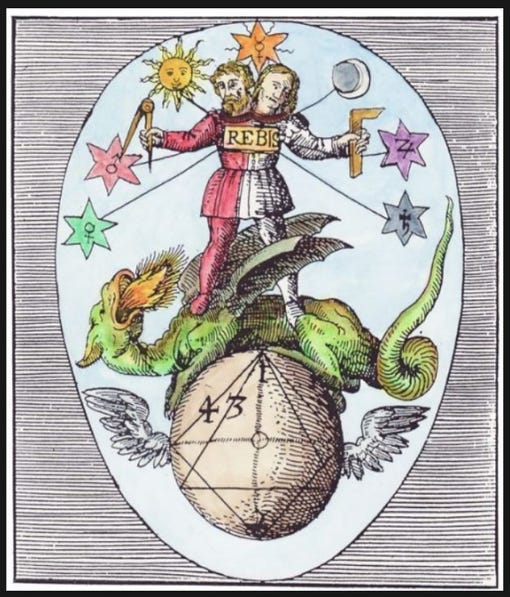
If you are like me, you often walk around feeling as though there are “two of you”—dual selves fighting for dominance.
And you are right: there are, in a sense, two personas struggling within us, like Jacob and Esau, Apollo and Artemis, Romulus and Remis, Horus and Set, and other dualistic twins hallowed in religion and myth.
Alchemical tradition posits the “divine hermaphrodite,” depicted atop this article, as the joining of eternal, complementary polarities: spirit and matter, deity and mortal, male and female.
I deem these models “real” in terms of the psyche—and something more.
We often experience the sensation of being “two selves” during periods of self-assessment, including when we feel divided between mediocrity and excellence.
People often harbor the conviction that they could become a writer, or could get straight A’s, or could excel at work, or could find a positive relationship—but who exactly could? We sometimes feel that such things are possible if only we could throw ourselves upon the energies of our higher, better, more formidable self or double, waiting to be integrated or released.
This possibility is real, but it is rarely, or only fleetingly, exercised.
Two of Us
Many modern fiction writers and psychologists, not to mention their ancient and folkloric forebears, have posited the existence of this “other self.”
Psychologist Carl Jung famously called it the shadow, which he identified as a fount of unacknowledged desires and proclivities; if recognized and integrated into your day-to-day consciousness, these shadow traits could lead to the growth of untapped powers, confidence, and abilities.
For fantasy writer Robert Louis Stevenson, the other self was the malevolent Mr. Hyde, a feral counterpart to the refined and gentile Dr. Jekyll. For Edgar Allan Poe, the other side was represented by “William Wilson,” the title of Poe’s 1839 short story in which his protagonist, the debauched Wilson, grows up alongside an uncanny double who shares his name, appearance, and birthdate, and who eventually turns out to be the maleficent hero’s alienated conscience.
Many fiction writers, like Stephen King in his 1989 novel, The Dark Half, see the other self as a figure of repressed violence and evil. But that reflects only one sliver of the split-self riddle of human nature. More important for our purposes, your counter-self can be a figure of relative fearlessness, effectiveness, and ability.
Author Napoleon Hill highlighted these possibilities in his 1937 self-help classic Think and Grow Rich. Hill wrote:
O. Henry discovered the genius which slept within his brain, after he had met with great misfortune, and was confined to a prison cell in Columbus, Ohio. Being FORCED, through misfortune, to become acquainted with his “other self,” and to use his IMAGINATION, he discovered himself to be a great author instead of a miserable criminal and outcast. Strange and varied are the ways of life, and stranger still are the ways of Infinite Intelligence, through which men are sometimes forced to undergo all sorts of punishments before discovering their own brains, and their own capacity to create useful ideas through imagination.
The Magic Story
One of the oddest modern inspirational works ever written, The Magic Story. features this theme of a positive double, which author Frederick van Rensselaer Dey (1861–1922) calls your “plus-entity.”
In Dey’s brief and strangely compelling instructional tale from 1900, he depicts the life of a down-and-out seventeenth-century craftsman who discovers that a haunting Presence, or other self, is hovering around his periphery. Dey’s hero finds that his counter-self is a real part of him, one that is “calm, steadfast, and self-reliant.” As soon as he comes to identify, literally, with his plus-entity, his life is happily transformed.
“Make a daily and nightly companion of your plus-entity,” the hero counsels.
As it happens, the author Dey’s life was less than happy: After a middling and prolific career writing pulp crime fiction, including the popular Nick Carter detective tales, the wearied writer shot himself to death in 1922.
He left behind a stoic suicide note, asking only that his older brother be taken care of. Dey’s widow, Haryot Holt Dey, was herself a notable writer and suffragist who lived until 1950. To use the terms of Dey’s own allegory, the author succumbed to his “minus-entity.”
Meeting Your Plus-Self
How can you get in touch with your stronger plus-entity? Here are some (deceptively) simple techniques.
Dress the Part
Never neglect the power of simple things. The manner in which you dress and comport yourself has tremendous impact on your psyche. Most people instinctively sense this without fully acting on it. Become a thespian, trying out, perhaps subtly at first, different styles of dress, makeup, accessories, and body art. In one of my favorite episodes of The Simpsons, a teacher tells young Lisa, “Being tough comes from the inside. First step—change your outside.” Like all good jokes, this one conceals a core truth. Magickian Anton LaVey referenced this process as claiming your “total environment.”
Feed Your Other Self
Furthering the theme of total environment, permit yourself to grow immersed in music, movies, and media that feed your sense of power and self-agency. As an example, consider the elegant but deadly robot named David in the 2012 science-fiction movie Prometheus; take note of how David studiously models his persona after the cinematic Lawrence of Arabia. Although brief, these scenes are no passing trifle; they are mini-models of the kinds of self-making that we all engage in, sometimes without awareness.
Talk Like It
Consider the manner in which you speak. I once knew a crime reporter at a newspaper in upstate New York who had a slight build and appearance—but he spoke in a commanding, self-confident bass voice. It earned him the respect of the police and his newsroom colleagues. Whether natural or affected (I could never tell), his voice altered his entire persona.
Find a Manifesto
You may question the value of reading The Magic Story given its author’s tragic end. Do not be deterred. Read it tonight. Make its lessons your own. Dey possessed a keen instinct for human nature, including its shadowy and occultic paths to power. If this work doesn’t speak to you (although I suspect it will), select another. Here is a start:

Stand for Something
The chief cause of mediocrity is purposelessness. We are never more aroused, sensitive, and capable than when we are striving for something. What are you striving for? A watch-the-clock job and entertainment will not summon more than your most average traits. Above all, you must find a chief aim in life. You should never be embarrassed by your aim. Your aim can be public or intimate. It requires no one’s approval—it must be uniquely your own. The only tragedy is not having one.
* * *
Since earliest childhood, you have probably felt, as I have, that you are two selves. Select the self that builds you. It represents a more powerful choice than may at first appear.
I'm currently reading your book, Practical Magick, and have literally just finished the chapter which talks about dress and comportment. I do like to create a look.
“The chief cause of mediocrity is purposelessness.” Don’t I know it. Must find purpose…