


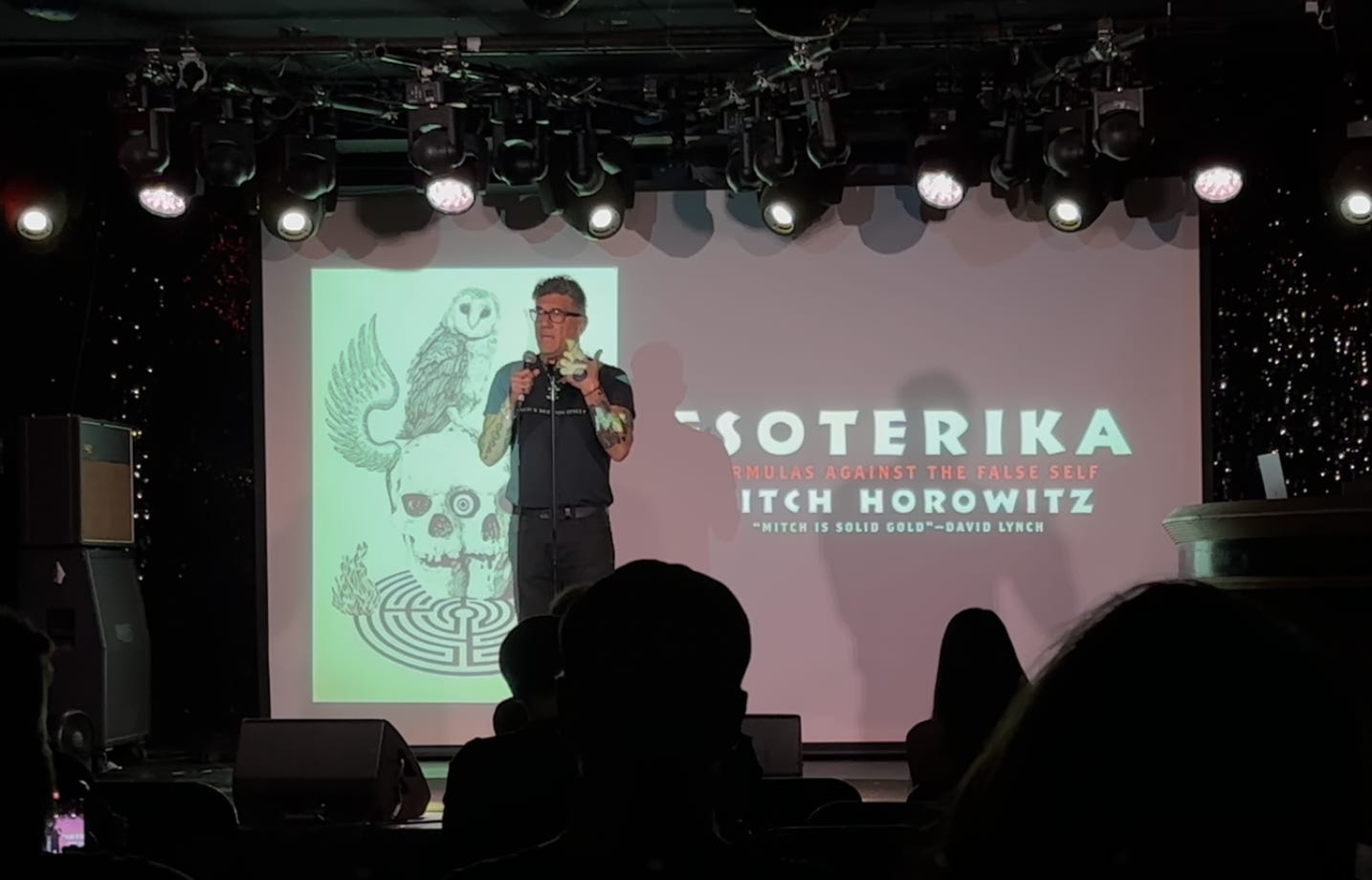
Friends, I am happy to present my full talk for the launch of Esoterika delivered on Summer Solstice, June 21, 2026, at the performance space TV EYE in NYC, including comments by fine artist John Newsom and audience Q&A. -M- x
I wrote Esoterika because I believe that a certain rot has settled into our culture of search, therapeutically and spiritually.
There exists a habitual thinking that touches all of us, that gets inside us, through recitation of ideas that grow intensely familiar by dint of repetition.
Very often these ideas reflect decisions made by someone else. They have gotten enshrined in what we consider wisdom literature or traditions.
We sometimes encounter these things in translations of translations of translations, very often in a different form than the original language. Very often the originals themselves are lost.
This is so with the Hermetic literature, for example. It’s difficult to believe, but we actually possess no original manuscripts or scrolls of the original Corpus Hermeticum, not only dated to Alexandria in late antiquity but also dated to the Renaissance, which, in terms of the time scale of human history, was five minutes ago. We are unable to even compare our Latin and English editions to the Byzantine Greek originals from the Renaissance.
Across centuries and sometimes millennia, the wisdom literature that reaches us is not only subject to continual re-translation but also insertion of ideas that whoever was translating the material at the time felt inclined toward, maybe sympathizing with one system or outlook or religion, and inserting word choices that may not reflect original intent.
What I have attempted in Esoterika, as much as a twenty-first century person is able, is to locate fragments of primeval traditions and try to find some sense of what our ancient ancestors were working with in their earliest search for truth. To try to find certain unconditioned ideas, or at least something close to them.
As much as I am capable, I try to translate some of these unconditioned ideas, ideas that have been couched and to some extent preserved within esoteric tradition, and to ask what such things can offer the individual in the here and now.
I feel strongly that certain very basic questions and wishes get taken from us in the current search. For example, I won’t shy away from words like happiness or failure or success—and I won’t allow these things to get taken from the sensitive individual, who I think is capable of defining them with profundity and practicality and application.
When people speak of happiness, or when people speak of a certain aspiration, sometimes they’re told, in so many words, “that’s superficial” or “that’s a product of a false self,” or “that’s a product of one of many ‘I’s’ inside you.”
All of that, as I see it, deserves to be subject to your own scrutiny and your own verification—because I believe that the sensitive individual, including the adolescent, is perfectly capable of defining and defending his or her conception of happiness.
I wrote this book to support that contention.
I try to provide some very simple ideas that I think knock down barriers between the individual and his or her wish for happiness and agency and self-expression in the world.
There’s a certain kind of suffering that pays a debt and that is valid and worthwhile. And there’s a certain kind of suffering that is waste suffering—the kind of suffering that gets visited on us by internalized peer pressure, which is what I call the false self in the book’s subtitle.
I want to offer you three ideas that I believe will greatly contribute to your sense of selfhood and your happiness—and that you need to subject to no one’s scrutiny and disclose to no one.
These three ideas appear in various forms in the book. I am going to be explicit about them right now.
I. What Is Your Wish?
One of the chief ideas that animates the book, and that you will find in the first chapter, is asking yourself, privately and with an exquisite lack of inhibition or embarrassment: What is your wish? What do you want from life? What do you most want to express? And don’t qualify it.
One of the ways that the present spiritual culture and peer pressure takes these things from us is that we find ourselves—even or especially within the private confines of our own psyches—diluting, qualifying, or conditioning a wish.
Words start to come up that do not necessarily belong to us, as though we must remake a wish in order to fit someone else’s conception of what the good is.
Your wish is self-justified because it is the thing that you are most desirous of creating or expressing, broadly defined.
The chief Hermetic principle that has reached us in various forms is: as above, so below. This echoes in Western Scripture as: God created man in his own image. If anyone takes that seriously, it stands to reason that the purpose of existence is expression. I think lack of self-expression is at the back of so much of the low-grade anxiety and depression and substance abuse and sorrow that some of us spend our whole lives locked within.
But when you arrive at that wish on your own private terms, without vetting it in front of anyone, without necessarily sharing it with anyone—you do not have to share it with your shrink or your spouse or your boyfriend or girlfriend—you will know its authenticity by feeling perhaps an intermingling of embarrassment and great happiness, because there’s a simplicity to your wish that requires no justification, no reframing, no adjusting.
It’s real. It’s actual. It probably has been with you since your earliest cognized memories, maybe even from ages three or four. And it’s so valuable to peel back those layers in private to that time. Ask yourself: What were your fantasies? What were your wishes at that very, very precious young age? Because you were not yet in the grip of peer pressure, which I suspect probably internalizes and concretizes in a person maybe around age nine, at which point we start to belong to the vast influence of the outer.
But the beauty is that perhaps the last reserve of absolute privacy in this hyperconnected society lies within the psyche. I define the psyche as a compact of intellect and emotion. Within that place, within that beautiful vault, lies your wish.
What is it? When you know it, it will be simple. And I beg you: when you find it—and you will find it—do not be concerned outright with whether it’s achievable or possible. Those questions have their place. They will come. But first and foremost, we mustn’t be strangers to ourselves in the way that conformity makes us strangers to ourselves. Because within that wish, you will find the thing that you want to express, which makes you a part of the schema of creation that seeks to replicate itself in order to self-experience.
There’s a rightness to it—let no one take it from you. Do not feel obligated to submit it or subject it to anyone’s judgment.
II. THINK
Another facet of the book lies within a story that is told about the spiritual teacher G.I. Gurdjieff (1866-1949), whose thought runs like a thread—or I should say my effort to encounter his thought runs like a thread—throughout this book.

There’s a story told. I can’t speak to its veracity. It may be apocryphal, but it’s certainly repeated and has vintage within the work that he brought to the West.
The story is that when Gurdjieff first visited America in 1924, and got off the steamer, a reporter said to him, “Mr. Gurdjieff, can you sum up your message for the people of America in one sentence?”
Gurdjieff paused and said, “Think.”
That was his answer. There’s a danger in this story because upon hearing it, the imagination says that it’s about somebody else. It’s always my neighbor who’s not doing the thinking. And there’s a danger of immediately applying it to politics or social issues or something like that—where it’s always someone else who’s not doing the thinking.
It’s all of us who are not doing the thinking. And the point, I believe, is that we are lopsided beings. We are divided in our functions among intellect, emotion and physicality. Intellect is by far the weakest of this trio of brains. Generally speaking, we are ruled by emotion. Gurdjieff compared emotion to a horse. It’s powerful. It’s mighty. It’s unstoppable. And when it hears a noise or when it encounters something that’s unsettling, it will bolt. The intellect is like a carriage or buggy driver who has no reins. The carriage or the buggy is like the body just getting bounced around, usually getting led around by emotion.
Solutions that are sometimes urgent can be found if the driver, the intellect, is able to assert him or herself a little more clearly. Or, at the very least, if the attention can be used to see the nature of the situation that’s playing out. It’s not uncommon that situations that can be very fearsome to us and very difficult to us can be handled far more adroitly if we’re able to use the thinking center more consciously.
Thinking means self-observation. Not coming to a certain conclusion, but self-observation.
There’s a radical act in that because, for most of us, most of the time, emotional and bodily urges are absolutely in charge regardless of the lullabies we tell ourselves in connection with our untested notions of being intelligent beings.
Think. Think as an act, as an effort, as a facet of being.
We harbor this belief about self that’s often unwarranted: that we’re thinking beings. Generally, we are not. But we have it within us to use our attention in a different way.
III. Right Relationship
In a third facet of the book, I make the effort to distill from esoteric wisdom something that I think can serve as a tonic to the sorrow and suffering of life. It is the absolute centrality of right relationship.
I have asked myself: what is the determinant of power in our world? I don’t mean power as a means of force, which is how most people hear it, but I mean power as a means of self-agency, power as a capacity to see through, in some reasonable measure, your plans and wishes in the world.
There are countervailing forces. Sometimes these countervailing forces are extreme. They might be physical. They might be natural disaster. They might be vaster currents of planetary activity about which we can do nothing. So resistances exist and will always exist. But power and agency are so basic to the human search and the human need that a paucity or lack of power can be agony.
But where does power come from? There exist certain brutal truths. Money, sexuality, security—these are levers of power in our world. To deny that would be just myopic. We rarely control those facets of life. They control us. They come and go in ways over which we have very little regulation.
But there’s another seat of power—and I ask that you listen to this very, very carefully. It could be the turning point of your life. Power is relationship. It is profoundly important for your happiness, for your agency, for your abilities, that you situate yourself within right relationship.
I believe that a terrible suffering—and a worthless suffering—that we visit upon ourselves, and that is visited upon us, comes in the form of being in the wrong kinds of relationships, the wrong kinds of company, of feeling that, due to peer pressure, due to convention, due to pageantry, due to family pressures or pressures of friends, we enter into situations and we remain within situations that deplete our sense of effort, ability, reserves, selfhood.
A point to which I return again and again in my work—and I cannot emphasize this sufficiently—is the absolute imperative for you the individual to get away from cruelty. And you can define cruelty. We do not need some chin-stroking exercise in what that is. I place my trust deeply in the individual to define these things.
There is nothing more vitally important in your life than separating from cruel people. Nothing. You will blossom. You will rediscover yourself.
The other day I was doing a podcast and I was asked if somebody were to take one idea from my work, what would it be? I immediately answered: get away from cruelty.
And the questioner, in a perfectly well-intentioned way, said, “What about cruelty within me? Is that something that I’m trying to get away from as well?” My answer is, that’s not my suggestion. My suggestion is get away from cruel people and then you can work on self. And then all kinds of things become possible on all kinds of levels. But like a house plant of deprived water, nothing functional can grow, nothing good can happen, in the midst of depleting relationships.
I place a lot of stock in the work of an author who is reviled by cynics—and that is Carlos Castaneda (1925-1998), whose tales of tutelage to a Native American shaman are considered sheer invention and just the worst kind of con artistry and phoniness. I’m perfectly capable of understanding the historic forensics. But within Carlos’s work appears genius and splendor regardless of what artifice he purposefully brought to it.
A fascinating passage appears in the first of his memoirs of studying under the sorcerer don Juan. In it, Carlos experiences a great deal of danger. There’s a witch who has it in for him. And don Juan instructs Carlos one night on his little porch that he’s got to find this spot on the porch that is his “spot of happiness” or spot of power. Carlos spends the whole night looking for this spot on the porch where he feels powerful. And he eventually finds it. And he finds it just in time because this witch moves in to attack him. And he’s able to repel the attack because he’s found that spot of power, that spot of happiness.
That is relationship. That is right relationship.
I ask you to think of times—it could be last night, it could be last week, it could be when you were ten years old—when you felt secure and consciously happy and seen and right within yourself. Those times hinge upon relationship. They hinge upon who you were with. We are relational beings. And in the same way that a plant needs a certain kind of soil, needs sunlight, water, seasonal climate, and so forth, so do you.
I am persuaded that one of the crises of this moment is that we are pushed to maintain excessive relationships. We likely encounter more people within a day than our primeval ancestors might have within their whole lives. Social media has something to do with that. I have a lot to say about social media in the book. Very little of it good. It promotes the worst aspects of human nature. The sarcasm, the rhetorical questions, the hatred. It’s unspeakable.
And it causes a deep sublimated shame in the people who engage in those things. To cope with that shame, the subject, like an addict, goes right back to hitting the bottle again and again, imbibing this false feeling of life that hostility and violence brings to us. Social media is deadly to the individual as much as it’s also a necessary part of life. The excess of relationship is something that we as a human community are unprepared for and unsuited to.
The search for power is properly defined as a search for right relationship. It exists—but it requires choices and it will be met with consequences. The consequences are usually milder than what a person expects.
For example, let’s say you have a family member or an in-law who is poison to you. You should have nothing to do with such a person. Literally and truly nothing to do with such a person. Not through some big confrontation. Don’t tell anybody what you’re doing. If you tell anybody what you’re doing, they’ll bring out the litany of usuals and say, “I was only joking . . . You’re being too sensitive . . . Well, logically . . . blah, blah, blah.”
If you tell the hive mind what you’re doing, the hive mind will make you its victim one more time. And it’s not necessary. It’s just not necessary. Everything in this book, almost everything, is exquisitely private in nature. It’s yours. It’s not something you have to present to somebody else.
We’re seeking fewer relationships, not more. Within fewer lies selection. Within fewer lies your process of determining what’s healthful, what’s right.
There are, of course, people stuck in cruel situations and relationships for reasons of economy, of livelihood, of geography—and they can’t do anything about it. That’s real and that’s true. And I speak to that person as well because a first step, as with your wish, is determining within, deciding within, acknowledging to yourself privately and within, the cruel and depleting and unnecessary nature of this relationship. And with that make a vow. Vow that although you’re stuck for now, you will, at the first possible moment, be physically free. And I warrant that once that vow is made, the physical freedom, while it may not come immediately, will arrive faster than you might expect.
When that opportunity arrives, take it. Take it.
To recap, I offer here three suggestions:
Focusing on your wish.
Thinking in a particular way.
Seeing relationship as cultivation of self, as pursuit of right power.
I validate these ideas by experience. I owe them to esoteric currents of thought within Hermetic tradition, within Abrahamic tradition, within some of the Eastern traditions, such as Confucianism, Taoism, Vedism.
I try to identify and be transparent about my sources. Some of them are Hellenic, some are early Jewish, some are Sufi, some are Christian, some are from the Lefthand Path. Others who have preceded us, our ancient ancestors, have within their worlds wrestled with these things as well.

We are not alone when we make this effort. We are part of a chain of seekers that extends to deep antiquity. As such, we stand to receive a gift. The gift is that some of these ideas are preserved within esoteric thought currents.
One of my mentors, the philosopher Jacob Needleman (1934-2022), who’s now dead, asked me, “What do you do when someone offers you a gift?” I stared at him blankly. And he said: “You accept it.”

This book is my invitation, best as I am capable, to convey the gift that has been communicated to us from the chain of seekers.
Please see the full video for John Newsom’s presentation and audience Q&A. Esoterika is available in print, digital, and audio, narrated by me:

Please join me July 12-17 at the Omega Institute:


