

Radical Optimism
the promise and perils of its leading philosopher

What is wrong with radical optimism?
It is a maybe. We all live by maybes, including those who commit to nothing.
“It’s blindness.” I am unmoved by such pseudo-pragmatism.
Since fortune is outrageous and unknown, everything is blindness, including existential grimness.
Since ultimacy—whether tragic or joyous (often a mix)—is, most of the time, abstract, we use its shadow to justify meanness.
Since we are mechanical, all human plans ring hollow.
That being so—choose.
Are you afraid to? Do not be. I have never met a seeker who did not build a roof in dry weather. Never. Nothing in this piece will compromise your life.
Let me clarify terms. A seeker is not someone who says, “I am spiritual” (which means nothing—spiritual is extraphysical).
A seeker holds a question.
I write, only and always, to the “happy few” who compose the latter.
In considering what attitude to take in life, this article praises a man whom I have criticized—and will further here, since I insist we “knock at both sides until everything has been considered,” as Confucius taught (Analects 9.8, Annping Chin trans.).
I reference the philosopher laureate of optimism Christian D. Larson (1874-1962).
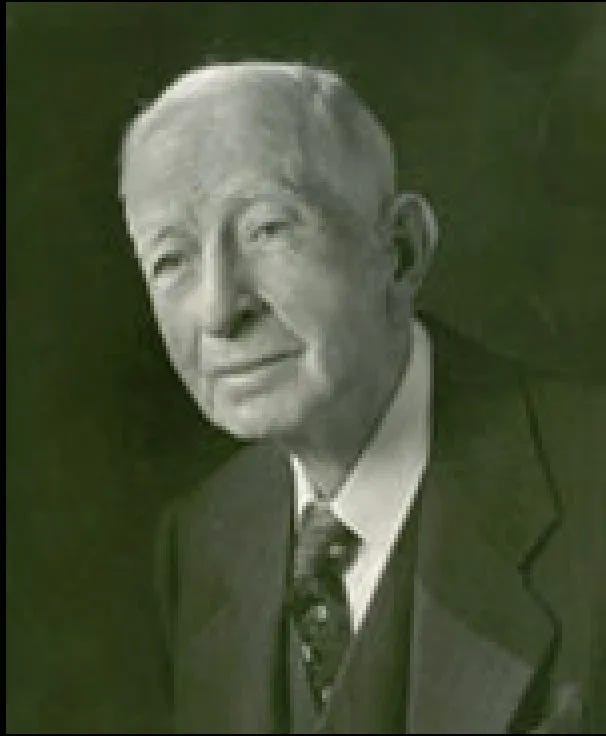
Even if you have not heard of him, you know his maxims. They are ubiquitous: “be all you can be,” “attitude of gratitude,” “live the simple life,” “make yourself over,” and “live in the present.”
Born to Norwegian immigrant parents in the near-wilderness of northern Iowa in 1874, Larson had planned on a career as a Lutheran minister.
But after a year at a Lutheran seminary in Minneapolis in 1894, he grew interested in Unitarianism, Transcendentalism, and the new mind-power philosophies sweeping the Western world, particularly following an experience of “cosmic consciousness”—the state of inner awareness and elevated perspective described by Richard Maurice Bucke (1837–1902) and William James (1842–1910). (See my source essay at the end.)
In 1898 Larson moved to Cincinnati, where he began writing and publishing New Thought tracts—the umbrella term for the nation’s positive-mind philosophies—and quickly burgeoned into one of the field’s most prolific and dynamic voices.
Some of Larson’s earliest writing featured phrases so widely adopted in general culture that their pen of origin grew obscured. Oprah Winfrey made “attitude of gratitude” famous fifty years after Larson’s death. In 1980, Larson’s “be all that you can be” became the famous—and since revived—recruiting pitch of the U.S. Army.

Another unheralded aspect of Larson’s career began in 1910 with “Promise Yourself”—a verse meditation on the power of determined affirmativeness. It gained worldwide notice in 1922 after being adopted as the credo of Optimist International, a philanthropic club similar to the Jaycees or Rotarians. The verse work was known ever after as “The Optimist Creed.” You can find it today hanging in break rooms, gyms, and on fridges.
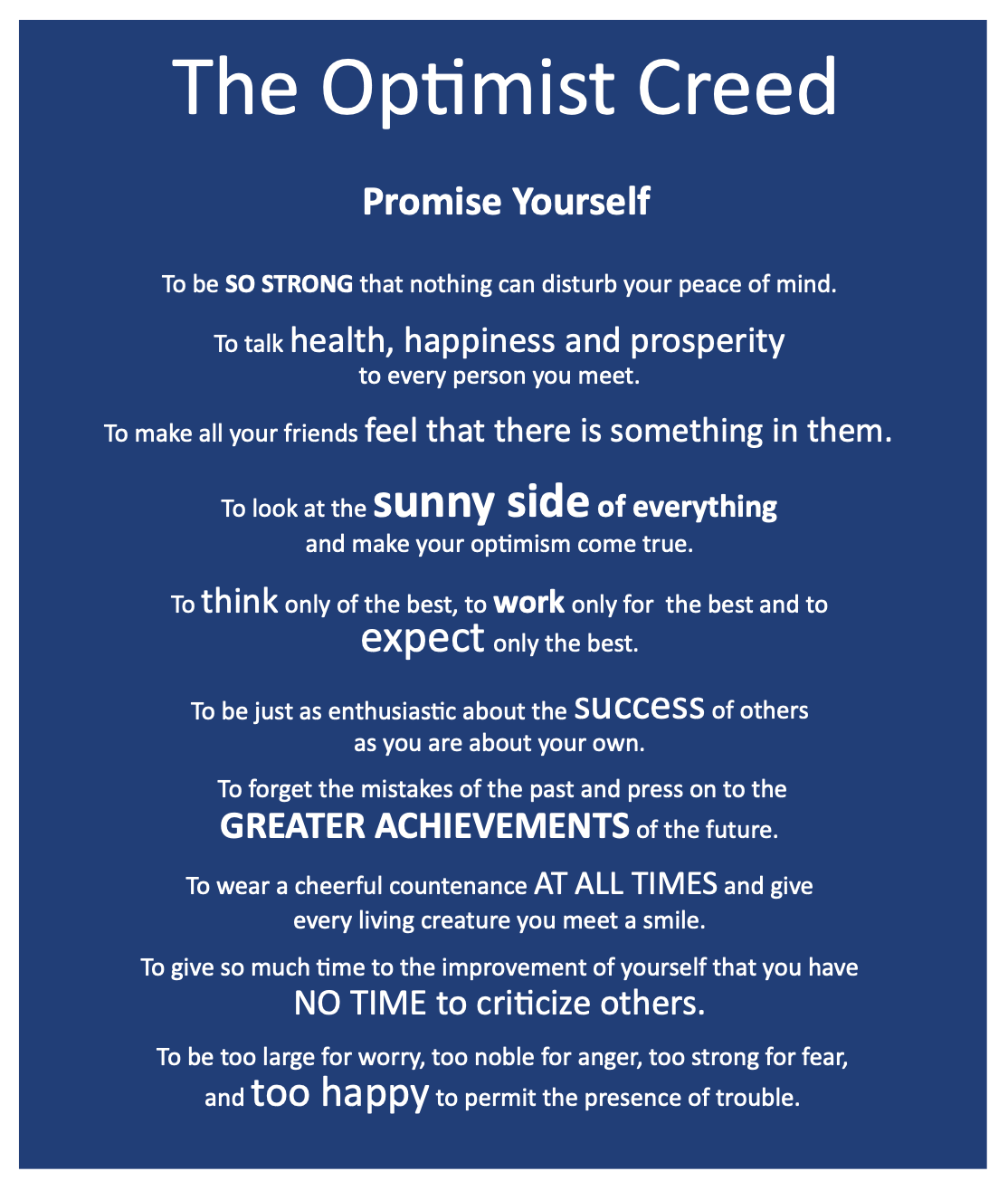
I wish to note something very carefully about the creed: most of it involves your actions toward others. Dwell on that.
I am not by nature optimistic. I am anxious. That is why alcohol and weed were—until a recent hospitalization with lingering questions—part of my nightly routine.

I do not revise the past and I do not hide weakness. My forthcoming Esoterika makes no effort to conceal those habits, even as they are now in my rear-view mirror.

My hospital stay reinforced something I knew earlier and to which I recommitted: you must see people and make them know they are seen. Everyone around you is, like you, desperate to feel seen. Even the internet dick—who gets no pass from me—wants nothing so much as to feel seen, albeit crouched behind anonymity (cowards want to feel seen).
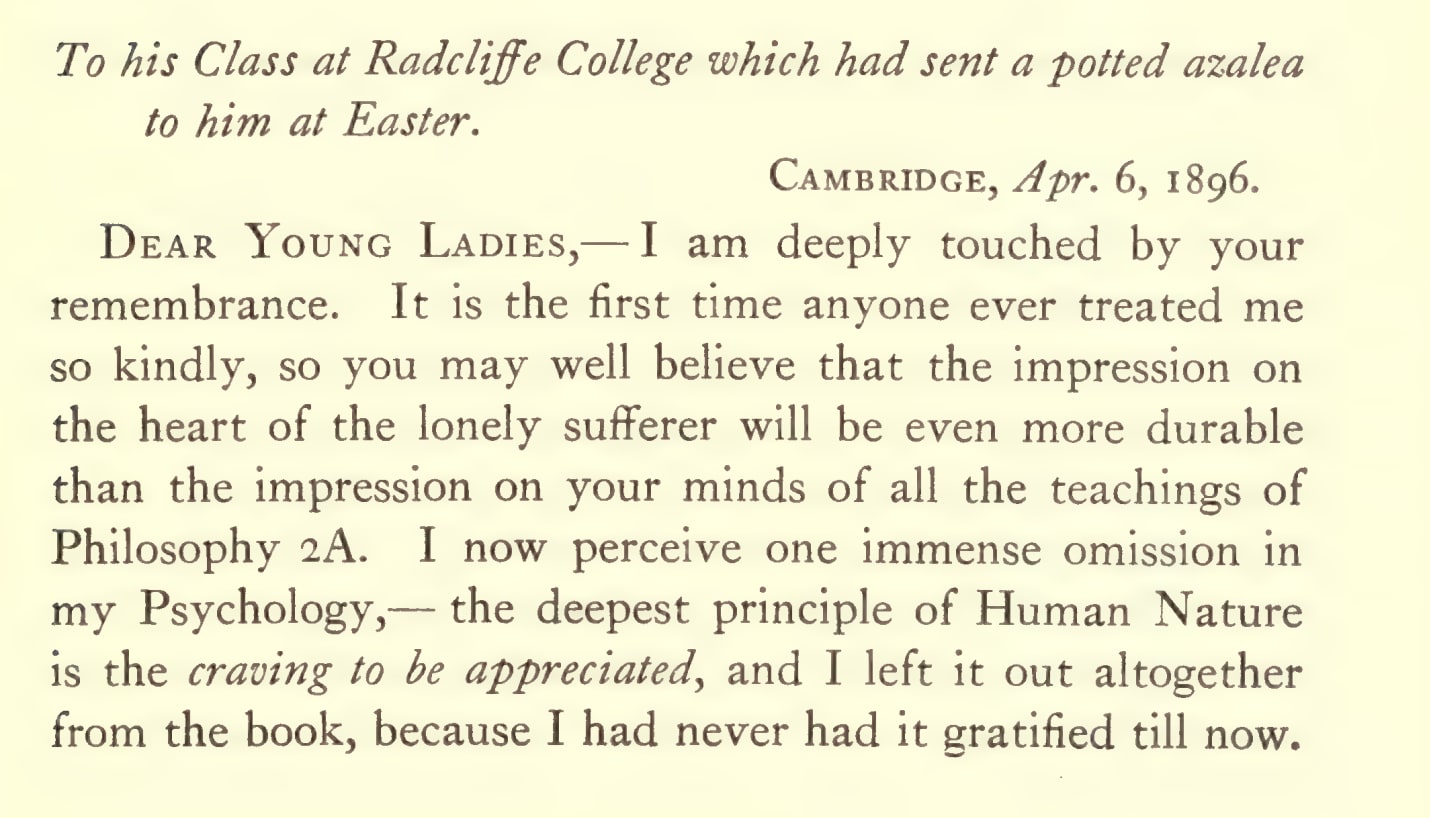
In his letters of April 6, 1896, William James wrote in thanks to students at Radcliffe: “the deepest principle of Human Nature is the craving to be appreciated.” If you recall this one principle, you recall The Optimist Creed in sum.
I do not write this cynically but practically: you will, in abiding this principle of seeing another, receive the best that people have to offer, whatever the nature of their work or your relationship to them. In seeing strangers—who can do no obvious good or harm to you—tendrils of redound will reach you.
I am not over-zealous on this point. Cruelty and disrespect deserve your backhand—get away from their purveyors. I am rough-hewn on such matters because if you do not protect yourself, predatory personalities will consume you. But your baseline offering in life should—must—be respect and seeing of another. Start there, always.

Back to our—soon-to-be-seen troubled—philosopher of the good.
For a time, Larson was enormously successful at publishing his own widely read books and magazines at his Chicago-based Progress Company. His monthly, Eternal Progress, launched in 1901, grew by the end of the decade into a handsomely produced, socially progressive journal that combined ideals of mind-power metaphysics with articles and photographs highlighting the nation’s bounding growth.
Alongside articles heralding New Thought’s emergence as “a universal religion,” Eternal Progress featured reportage and illustrated spreads on great dams, railroads, skyscrapers, and other engineering marvels that fueled optimism about the future in the early twentieth century.
A typical issue of Eternal Progress chronicled the rebuilding of San Francisco after the 1906 fire and earthquake, and the beauty and growing economy of the Pacific Northwest, with its logging and fishing enterprises. Larson also ran articles calling for universal suffrage and the creation of public programs to educate and reform prisoners.
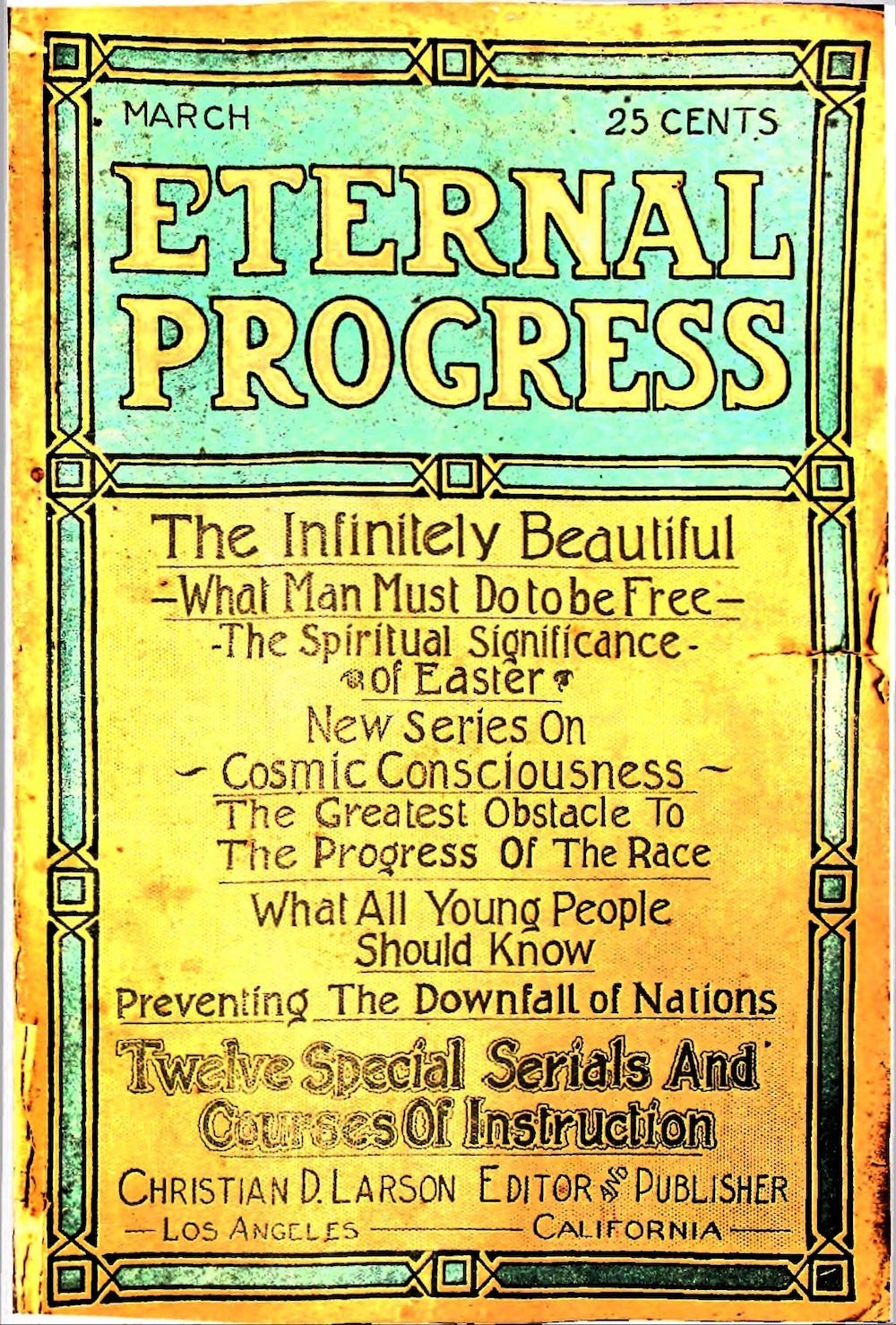
Perhaps like no other magazine of the period, Eternal Progress captured the full-circle culture of the Progressive Era: bounding commerce, scientific advances, working-class struggles, social reforms, and the appeal of the new mental therapeutics. The zeitgeist of limitless potential appeared in Townsend Allen’s poem “Eternal Progress” featured in the issue of March 1909:
From the first primeval atom,
Upward, upward is the trend;
Greater out of lesser growing.
Ever to the perfect end.
Upward, onward, each to-morrow
Should be better than the past;
God’s work in His creation;
All who will may win at last.
To broaden the magazine’s appeal beyond the metaphysical, the arriviste publisher shortened its name to Progress in June of that year, a decision he later reversed.
While displaying a serene demeanor and relentlessly upbeat tone, Larson pursued a dual existence as both a visionary author who shaped the language of self-help and a sharp-elbowed businessman who violated ethical boundaries in his publishing empire.
For all Larson’s ideals, the visionary communicator displayed a pattern of tortuous and compromised business dealings.
On July 25, 1911, the U.S. District Court for Northern Illinois declared Larson’s Progress Company in “involuntary bankruptcy” following complaints from creditors who were owed a whopping $300,000. The court ordered a receiver to take control of the company’s plants and holdings, and suspended publication of Larson’s 250,000-circulation magazine.
By August, Larson had left town for Los Angeles. He later told an interviewer that his Chicago printing plant had burned down and, rather than rebuild, he decided to follow the country’s momentum and move West.
At the time of the Progress Company’s receivership in 1911, however, creditors estimated that the company continued to hold plant and printing assets of about $100,000—a surprisingly robust sum for a business that Larson said was lost in a fire. Closer to the truth may be that Larson, facing mountainous debt and scorned creditors, opted to act on his principle to “make yourself over” and left his liabilities behind to “reinvent” himself in Southern California.
Once in Los Angeles, Larson covered his tracks. He took one of the last books published in 1910 by his Progress Company, Your Forces and How to Use Them—he lifted the title without credit from the signature volume by essayist and New Thought acolyte Prentice Mulford (1834–1891), who died nearly twenty years earlier—and reissued it, switching the copyright year from 1910 to 1912 and changing the name of the copyright holder from the Progress Company to himself.
He probably did this to shield the book from his Chicago creditors. This book contained Larson’s “Optimist Creed.” His switch in copyright dates, from 1910 to 1912, created the lasting misimpression that the world-famous meditation appeared two years later than it actually did.
Larson repeated this practice with several other works. In 1912, he reverted the name of his magazine back to its original title, Eternal Progress, and resumed publication.
At least journalistically, Larson had not lost his taste for social justice, as he inaugurated the renewed publication with an essay contest offering $100 for the best article on “The Cure of Poverty.” (My imagined submission: “Stop Ripping People Off.”)
Larson exemplified the conflicting ideals that could mark the early New Thought movement. Seen from one perspective, the prolific author meant what he wrote about the power of thought to impact events, which he articulated in more than forty books until his 1962 death.
In fairness, critics often failed to appreciate the depths of passion and sincerity necessary for any writer to energetically produce that kind of output—much of it, in Larson’s case, appealingly readable.
When Larson’s message reached people who had been raised in religiously repressive settings, or amid the suffocating peer scrutiny of small towns, it could arrive as a vivifying gospel of self-will.
Yet Larson displayed a quality found in another mind-power pioneer and likely perpetrator of securities fraud Fenwicke Holmes (1883–1973)—Larson issued a correspondence course taken by Fenwicke and his better-known brother Ernest—who made ethical compromises on the path to self-improvement.
Simply put, this quality was Larson’s unnerving ability to avert his gaze so completely from the pale side of life—as in his debt-ridden Chicago past—that his sunny metaphysics concealed a lack of personal accountability. This moral conundrum intermittently colored the positive-thinking movement for decades, as it does today.
Do I contradict my opening? No. I have been betrayed by people who wax poetically about life’s golden rules and those who could not care less. Ethics and words are disparate entities. Those who cry a-ha! at the abuses of a figure like Larson do so only because such missteps are exposed by me—his literary supporter and historical interrogator.
Do you wish for good ethics? Me too. Find them in self. Here I return to Confucius who has lately been on my mind for just this reason: "The Master said, 'Is humaneness far away? As soon as I desire humaneness, it is here.’” (7.30, Chin trans.)
The people who cry evil—the unicorn of ethics—allow houseplants to wither. And evil—it proceeds like the tides amid their pixelated protestations.
The extent to which Larson was privately sincere is debatable. In that vein, he displayed an oddity of personality captured by author and editor Maude Allison Lathem in her 1940 interview for a class offered by the Science of Mind movement.
“Innately,” wrote Lathem, a collaborator to Ernest Holmes, “I believe that Mr. Larson is a timid man. He is quiet and reserved in manner and certainly conservative in his speech.”
“Speaking of his conservative nature,” Lathem continued:
when I went to interview him, I took with me a copy of “Practical Self-Help,” a book that had helped me greatly almost twenty years ago. True, I didn’t expect him to autograph it, “With love and kisses,” as some professionals might do. I have only known him personally a few years, but he has written many things for our Science of Mind Magazine and lectures weekly at the Institute of Religious Science. But all that he put in my autograph was: “Christian D. Larson, March 6, 1940.” Wouldn’t you call him conservative?
Yes, I would. The writer’s reserve perhaps concealed a sharper and less idealistic core than the inspirational trailblazer wished the public to see.
I say: spit out pits—and swallow the fruit sown by this compromised philosopher of affirmatives. Or if what I have written makes his fruit too sour, work with my ideas, which are ethically transparent. Try.
Notes on Sources
The date of Larson’s death is often reported as 1954. According to California state death records, the author was born on February 1, 1874, and died on June 10, 1962.
The phrases noted from Larson’s work appear in The Ideal Made Real (Progress Company, 1909), with the exception of “be all that you can be,” which appears in Your Forces and How to Use Them (Progress Company, 1910). This book should not be confused with Prentice Mulford’s six-volume namesake, Your Forces, And How to Use Them, issued beginning in 1890.
Sources on Larson’s background and career include the transcript of a 1940 interview / oral history that Larson gave to Maude Allison Lathem—a literary collaborator to Ernest Holmes—as part of an “Extension Course in the Science of Mind” offered by Holmes’s Institute of Religious Science.
Also helpful are two highly engaging profiles: “The Living Legacy of Christian D. Larson” by Mark Gilbert, Science of Mind, October 2011, and “The Pathway of Roses and Christian D. Larson’s Journey in New Thought” by Jessica Hatchigan, which appeared in Science of Mind, April 2005, and was reprinted in a reissue of Larson’s The Pathway of Roses the same year by DeVorss.
Also see “The Literature of ‘New Thoughters’” by Frances Maule Björkman, The World’s Work, January 1910.
Progress Company’s involuntary bankruptcy is reported in “Progress Company in Bankruptcy,” The Inland Printer (Chicago), September 1911. In her history paper, Lathem reports that “the plant burned to the ground;” in the same oral history Larson described relocating to Los Angeles in August 1911. Also in that interview Larson identified the circulation of his magazine as 250,000—a remarkable figure but one that squares with the overall finances of his company.
Sorting through Larson’s trail of copyright registrations and re-registrations entailed reviewing U.S. copyright data, library catalogue entries, publishing trade notices, and various editions of his books. In July 1912, The Editor, a literary trade journal, noted that Larson was restarting Eternal Progress; that article also reported his essay contest.
Fenwicke Holmes discussed Larson’s personal influence in his biography Ernest Holmes (Dodd, Mead, 1970).
The note on the correspondence course appears in Who’s Who in New Thought by Tom Beebe (CSA Press, 1977).
For further background on Larson’s “Optimist Creed”—originally published as “Promise Yourself”—see my discussion of June 27, 2012, with journalist David Crumm at readthespirit and the Larson anthology The Optimist Creed (Tarcher/Penguin, 2011), which I issued.
The promise and perils. Reflective and reflexive. A direct transmission to ponder our own paths, then act accordingly. I look forward to the next. Thanks Mitch. /bow
Thanks for this well-rounded look at a writer whose books I have appreciated for many decades. Reading a book like “The Pathway of Roses”, one can almost feel the power pouring from the pages.
Although I don’t really know, I wouldn’t be so quick to classify his “conservatism of speech” as an inner failing or sign of lack of conviction. Knowing-as he seemingly did-of the true power of the spoken word, perhaps Larson was “exercising greater silence”, as Mitch wrote in his recent “Shut Up” essay which we all liked so much. Maybe Larson eschewed superfluous speech. Personally, I prefer that to some of the smarmier New Thought and “prosperity gospel” types of today.
In the “Finding the Lost Word” chapter of “Pathway of Roses” Larson writes the following. Knowing this, I too aspire to be more careful in my speech:
The great word is not a word, as many suppose, nor a definite statement of truth. The great word is the soul of every word, the spirit of every thought and the inner power of every expressed statement. In the minds of the great majority it is a lost word, because their speech does not have soul, their thought does not have spirit, and their statements of truth, or untruth, are devoid of inner power. But those who are learning to live, think and act, not as material personalities, but as Sons of God, are finding the great word; they are beginning to speak with authority, and there is hidden power in everything they say. What they say will come true, does come true; what they think they can do they gain the power to do, and their work invariably contains some exceptional quality that the ordinary mind cannot define.