

Esoterika
the hour is late—if esoteric and occult philosophy have practical help to offer, let it be now

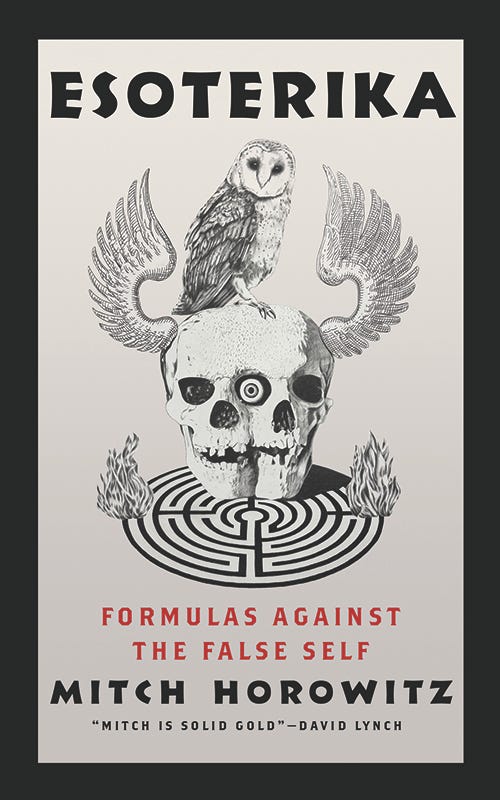
Friends—I address you as a friend if you have an authentic question—I am posting a free preview of the introduction to my forthcoming book, Esoterika (June 16). This book is astringent. I have paid in advance—as we often do—for its astringency. It is also written with a great wish for your happiness. -M- x
Every generation believes it lives on a precipice. That is near-universal. Historically, our era differs little from most in its apocalyptic expectancy. But a different and, in my view, more pernicious spectre haunts our age.
It is the nearly global attitude that we are living an unreal existence: blinded by artifice, strangers to ourselves, and acclimated to ersatz reality.
Our alienation, broadly gnostic—echoing the late-ancient sects who rejected the material world as the simulation of a false deity—plots our most popular movies, books, television shows, and video games; this media resonates with international audiences across disparate cultures. Simulation theory haunts us. The Matrix is our Beatles.
If there is one thing that everyone can seem to agree on: we are not ourselves. This sensation is correct.
The pangs of doubt we feel toward ourselves and our surroundings are responses to the automaticity of our existence. We traverse life with a menu of, say, twenty responses, and claim selfhood. That is not real existence. Neither we nor others around us are functioning as beings supposedly made in the image of a creator or as the likely older Hermetic dictum goes: as above, so below.
In Western culture, our unease is compounded by loss of civility, technological displacement, and directionless prosperity, which are producing a generation of ennui, rage, and despair. To that, I have no macro solutions. But I do have formulas that expose the narrowness of our being—our false being—and that, frankly, take a goddamn hammer to what keeps us there. Along with that hammer come a lot of ideals and high wishes for your happiness.
The hour is late. It is time for unwanted guests to leave.
***
My title word esoterika is, like magick, a purposeful rupture with common usage. Beneath its banner, I join esoteric (inner) and occult (hidden) teachings not only in exposition but direct application to your immediate life.
To achieve this, Esoterika brings unseen philosophy into explicitness and practicality. Viewed traditionally, my effort reflects a downward octave. Or, in exoteric terms, entropy. The stress and digitized hyper-stimulus of current life demands it. In any case, descent is lawful; damning it is damning the seasons.
The “false self” referenced in my subtitle is, in part, the product of conformity, a force from which none of us is ever free. For the grounded individual seeking greater self-agency, fuller personal expression, and—not quite freedom, a jejune and impractically distant ideal given the forces, metaphysical and physical, arrayed against us—but rather dignity within circumstance, some modicum of accelerant is needed. A hammer, too, is needed. This book is it.
Our present age requires a philosophy of results. What good is amassing knowledge, customary or symbolic, when such things fail to penetrate and transform? It is the equivalent of reading—or worse, reciting—a recipe to sate hunger. Esoterika is no recipe book. It fosters self-development. The book’s “formulas against the false self” are necessarily incomplete but potent. A formula is a concise expression within the sciences. That intent animates my effort.
***
The ideas in this book emerge from rejected or discontinued threads of Western esotericism and occult philosophy. Obscurity has, for now, spared these esoteric insights from dilution and reification.
I reconstitute neglected fragments in Esoterika from Hermetic (Greek-Egyptian), pre- or early Abrahamic (Judaic-Christian-Sufi), and modern esoteric traditions, and wed them to my own lived experience, which is, I warrant, yours too—as no life is exclusive.
Everything in this book is something to try. Not everything in this book is an outlook to share; if I wanted your agreement I would write a polemic. I want your understanding that tools of the psyche—an amalgam of intellect and emotion—are greater than we know, and that religious-philosophical history, as a container of such tools, reaches us through conditioned acceptancy, which several of my historical references and chapters work to interrogate.
My effort is, in a sense, schismatic. It reflects no single thought school. Philosophically, it is a mutt. But, as verified through your use, these formulas directly address, and leaven, our present predicament. As such, a particular potency resides in these chapters. Their ideas, if practiced seriously, will change you in positive ways. You will be more agentic, expressive, and, hence, happier. For the determined, this change occurs quickly.
I mean this so fully that chapter one offers, at some authorial risk, a chin-out exercise in wishing. It is the snake in the garden.
***
Some pedants debate the nature of “real philosophy.” It is like debating real medicine. If a method proves therapeutic, it is real in the sense of soundness, verity, and relevance.
I see no other principles worthy of your search.
In that vein, personal philosophy must be measured in the conduct and experience of the seeker. This ideal dwells in the thought and soundest interpretations of Hegel, Nietzsche, Emerson, and the mystical and classical masters of antiquity, from the Vedic families of India to Confucius to Plato.
Since relatively early in the modern revival of the search for ancient spiritual origins during the Renaissance—by spiritual, I mean extraphysical—the outlook I embrace has been grouped under the English term occult from Latin occultus for secret or hidden. Within Renaissance culture, occult labeled rediscovered shards, sometimes posthumously reconstructed, of interrupted religious ideas from Egypt, Greece, Rome, and Persia. The central idea of occultism, conceptually simple yet implicitly seismic, is the existence of unseen dimensions or intersections of time, all possessed of their own events, causes, intelligences, and perhaps iterations of ourselves; the influence of these realms is felt on and through us without mediation by religion or congregation.
In strict terms, occultism is a Western concept. There exist esoteric (from Greek esoterikós for inner) teachings within Vedic, Buddhist, Animist, Taoist, Confucian, and Shamanic traditions around the world—but occultism emerged from the West’s rupture with its religious roots during the rise of the Abrahamic religions, particularly early Christendom as distinct from the philosophy of Christ.
In an important demarcation, occultism differs from esotericism. The esoteric usually corresponds to an exoteric or outer counterpart, generally a traditional religion of which esotericism reflects the inner core. The occult is independent of religion—though not necessarily rejecting of it. My term esoterika unites both occultism and esotericism in application and immediacy.
I use another term, already referenced: magick. British artist and occultist Aleister Crowley (1875-1947) revived the early modern English spelling to distinguish it from stagecraft. His effort inspires mine. I define magick as causative ritual. It is perhaps the razor’s edge of philosophical application. Magickal agencies, whether metaphysical, psychological, or some combination, are ponderable. Their worth, like everything offered here, is measured in impact on the individual. Anything else is a matter of taste.
Lamplights
Most mainstream intellects and pedagogues consider occultism—when they do at all—as gimmick or superstition. Frankfurt School philosopher Theodor W. Adorno wrote in his essay “Theses Against Occultism” in 1947: “Occultism is the metaphysic of dunces.”
He was wrong. I evince his error. Yet Adorno’s guild-view helped me realize that many of the intellectuals I admired growing up were susceptible to judging category of query versus scale of quality, or topic over treatment. That is the barstool next to ersatz seriousness. Overused, it leads to dowdiness and foolishness.
We are all generalists—there is no escaping that. But using general knowledge to determine what to study and why invites oversight. Worse still, some scholars omit such lines of inquiry altogether. Distinguished historians and biographers often neglect occult-influenced episodes and relationships—sometimes of a pivotal nature—in the lives of their subjects, including Frederick Douglass (hoodoo), Mahatma Gandhi (Theosophy), Charles Lindbergh (Spiritualism), Theodore Dreiser (paranormalism), and Upton Sinclair (telepathy).
Having stated that, I wish to note my positive influences. Several names recur throughout in this book but here I reference some who may not appear explicitly. They undergird my effort without necessarily sharing my viewpoint. One is British historian Frances Yates (1899-1981) who wrote several pioneering books about the influence of occultism, Hermeticism, alchemy, and Kabbalah in early modern life.
Her work roused academic letters to at least fitfully acknowledge the impact, intellectually and historically, of occult thought, which most historians had, due to cultural affinity with philosophical materialism—and reasons little deeper—conscripted to obscurity and frivolity.
The Occult Philosophy in the Elizabethan Age, published in 1979, was Yates’s last full-length book before her death in 1981. Discovering it at a transition in my early thirties, I found the work revealing, meticulous, and resonant with the basic but neglected question: what have we missed? That query saves ships from sinking—and intellects, both individually and generationally, from ossifying.
Occultism, as Yates saw it, is a modern reclaiming of the Egyptian-Greek-Roman-Persian fragments of mystical and Hermetic philosophy, infused into ancient philosophy and pedantry, but often lost in particulars. The central Hermetic idea is psyche as medium to greater dimensions and, hence, instrument of spiritual expansion. Although it exceeds my scope here, I must add that Hermeticism as a philosophy has reached us in pieces. Of the Corpus Hermeticum, the Renaissance-era translation of late-ancient philosophical tracts, we possess no originals, neither Alexandrian, Byzantine, nor Florentine. Intervening centuries have produced varying—and necessarily subjective—translations and textual shuffling. I consider this theme further in chapter ten.
The Renaissance and early Enlightenment, including the triumph of heliocentricity, liberal query, Romanticism, and developing fields of modern medicine, engineering, and chemistry bear indelible markings of occult revivalism, Christianized Kabbalah, alchemy, Hermeticism, and Freemasonry, arguably the final outpost of Renaissance occultism. Early Masonic lights appear among key founders of the British Royal Society, a bastion of Enlightenment thought.
***
I discovered esoteric Egyptologist R. A. Schwaller de Lubicz (1887-1961) through the memoir Al-Kemi: Hermetic, Occult, Political, and Private Dimensions of R.A. Schwaller de Lubicz by André VandenBroeck. I encountered this work of esoteric intrigue in 2005 on the brink of my authorial career. It fortified my conviction that occultism is, at its subtlest, not only intellectually sound, but thrilling.
The 1987 portrait of Schwaller evokes strange memories filled with vulnerability. Its mysterious author, VandenBroeck, was then living in retirement at a hotel in Mexico managed by his son. His publisher gave me his fax number. “I do not participate in the internet,” VandenBroeck wrote me. He sent a friendly fax in response to my initial outreach noting that he used to live on New York’s Hudson Street where my publishing company then sat. Thereafter he went silent. I had the impression, perhaps retrocausal in nature, that he did not wish me to write an expository appreciation of his book. His publisher, too, previously friendly, went silent.
My path is not theirs. It is one of exposition. Ancient logic is splitting one to get two. Modern logic is adding one to get two. Exposition is not l’expérience (which can also mean experiment) but, as Schwaller observed, it is next best.
“The reason for this lack of contact,” André wrote in Al-Kemi, “holds no mystery: he [Schwaller] did not believe in language. Yet it is through language, both his and mine, that I discovered him.”
My work, in its practical vein, attempts—with clinical data (very modern)—to elucidate the language of Schwaller’s ineffable truth of time as “spherical spiral” versus progressing line. It is my effort to drag the ineffable into what literary critic Irving Howe—another intellectual hero growing up—in his 1986 The American Newness called “the shallows of the explicit.” That is the job I have assumed. It was open and I accepted it.
***
These were not my only influences. They also include the writing of Richard Smoley—in particular, his 1997 essay “Masonic Civilization.” It first ran in the Alexandrian-scale journal Gnosis.
Richard demonstrated, in sparkling prose and thought, how esoteric questions of true impact lie just beneath the floorboards of outer life, including enduring Masonic influence on American framings of free speech and protection of the search for meaning.
A later influence arrived in the work of artist and author Carl Abrahamsson, who demonstrated a depth of thought in Satanic, Thelemic, and Lefthand paths that I had not previously sensed.
I am also shaped by the writing and philosophy of Jacob Needleman (1934-2022), who I published for years. His work elevates the capacity to sustain doubt. Ex nihilo certainties kill the search. Intellectually, if not personally, Jerry, as friends knew him, displayed no such resting points. He titled one of his essay anthologies, now unavailable, The Indestructible Question. I embrace that principle. It is the only measure—sincerity of question—by which I choose colleagues.
I had literary heroes from my youth—most of whom would have proven indifferent if not averse toward the topics I later embraced—including the aforementioned Irving Howe (1920-1993). Following Irving’s memorial service, the widow of socialist philosopher-activist Michael Harrington—another influence, who we lost too soon in 1989—took my hands and said: “Mitch, standards. If you want to learn one thing from Irving, that’s it. Standards.”
Through these figures, to which I add scholar of religion Jeffrey J. Kripal and historian Joscelyn Godwin, I also detect intimate linkage between posterity and generosity. Without generosity—of thought, query, and character—vines of influence wither. Greatness of intellect cannot exist without generosity. Be careful how you read that. In the search, generosity is not indulgence but exchange.
Anonymous figures, one in particular, appear throughout this book. I withhold names due to veneration. I wish to suggest no association to my credit undeserved.
“Spiritual Means Truthful”
One of the chief barriers to the search is recitative wisdom, i.e., that which we glean from translations of translations of classical and ancient literature, which we then repeat to ourselves and others so often that certain concepts appear intrinsically true. Hence, they form premises from which to search. This usually dictates outcome, if any occurs.
Presently, my search is dedicated to seeking pre-consensus or primeval ideas in ancient religion and ethics—again, they reach us fragmentarily—before such things grew codified and conditioned.
In that framing, an interesting topic is anger. Across the traditions, as they endure, anger is understood, I assume rightly, as destructive. But there exist contrary perspectives.
In the Vedic guide to civil conduct, Arthashastra (earliest form 4th century B.C.), the semi-legendary sage Bháradvája, who lived before recorded time, is attributed with a dissenting statement about the destructiveness of anger:
No, says Bháradvája, anger is the characteristic of a righteous man. It is the foundation of bravery; it puts an end to despicable (persons); and it keeps the people under fear. Anger is always a necessary quality for the prevention of sin. (1915 translation by R. Shamasastry)
David Lynch told me in a 2016 interview: “This thing of righteous anger is fine, you can be against something, really truly against something, and fight for something you believe in. You’ll have more energy to do that. You’ll have more power, more edge to really get in and get the thing the way you want it.” He said this in reference to Transcendental Meditation, a practice I share.
Do not rush heterodox ideas into hasty application. Do not embrace them without context. Even Bháradvája’s brief statement contains several folds. I offer this digression because I wish to signal that dissenting ideas populate this book. My dissents may interest readers who wonder, as I once did, what the path offers those of us disappointed with the main roads.
Writing from off the main roads, I have, at times, asked whether in truth’s service I am negative. There is a hardness to this book. It is in the form of calluses. In his 1919 disruption of materialist science, The Book of the Damned, Charles Fort (1874-1932), whose full dimensions philosophically have not yet been understood (outside scholar Jason Jorjani) writes: “Our acceptance is that Evil is the negative state, by which we mean the state of maladjustment, discord, ugliness, disorganization, inconsistency, injustice, and so on . . .” You will find none of that in Esoterika. You will find astringency—with ideals. You will also find validation of something else David Lynch said: “Spiritual, I guess, means truthful.”
Postscript: About the Cover
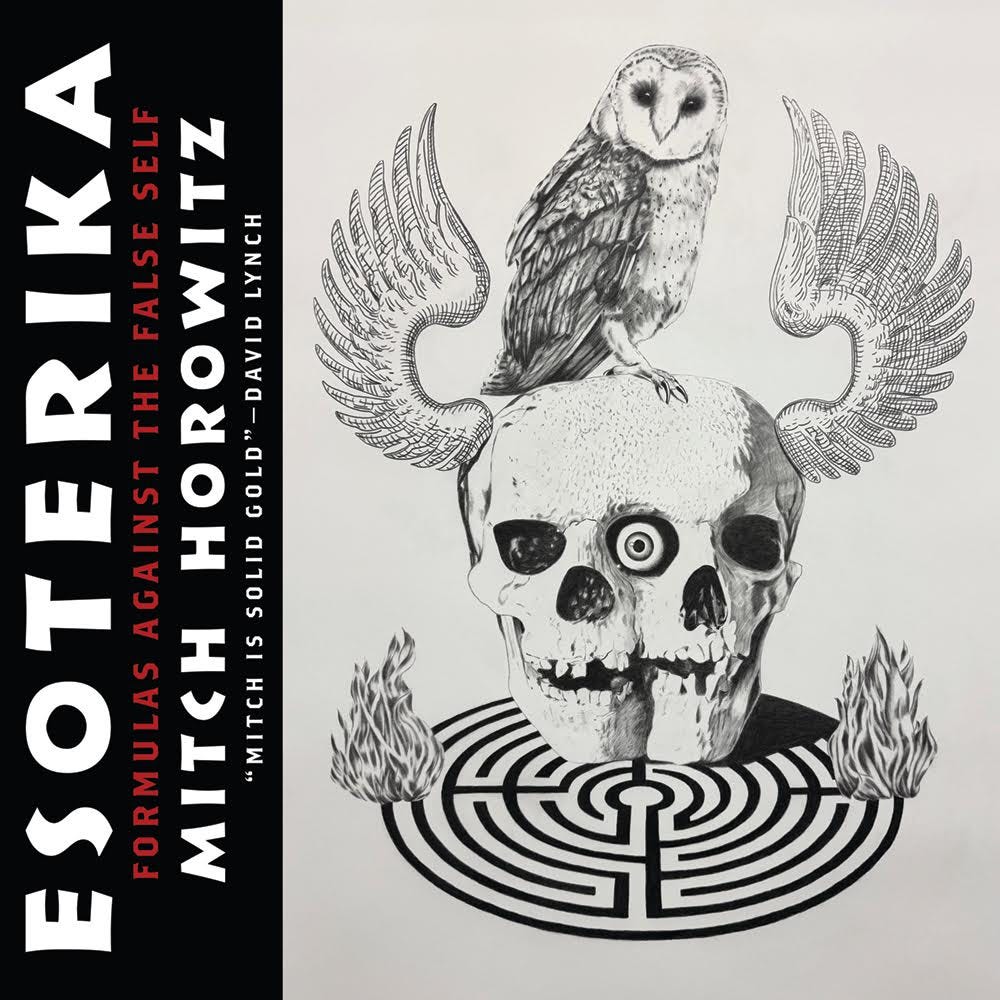
The cover by fine artist John Newsom shows the reconciling wisdom of the search: the owl—both predator (protector) and seer in the dark—perched atop the active and passive efforts of temporal life, themselves situated on a labyrinth of seeking amid the twin flames and wings of effort. The owl anoints the unified eye of vision: knowing of self; being and intention joined within the concentric circles of existence. John did not know this when I asked him to create the cover, but my teacher—quoted many times in Esoterika—was deemed an owl by one of his.
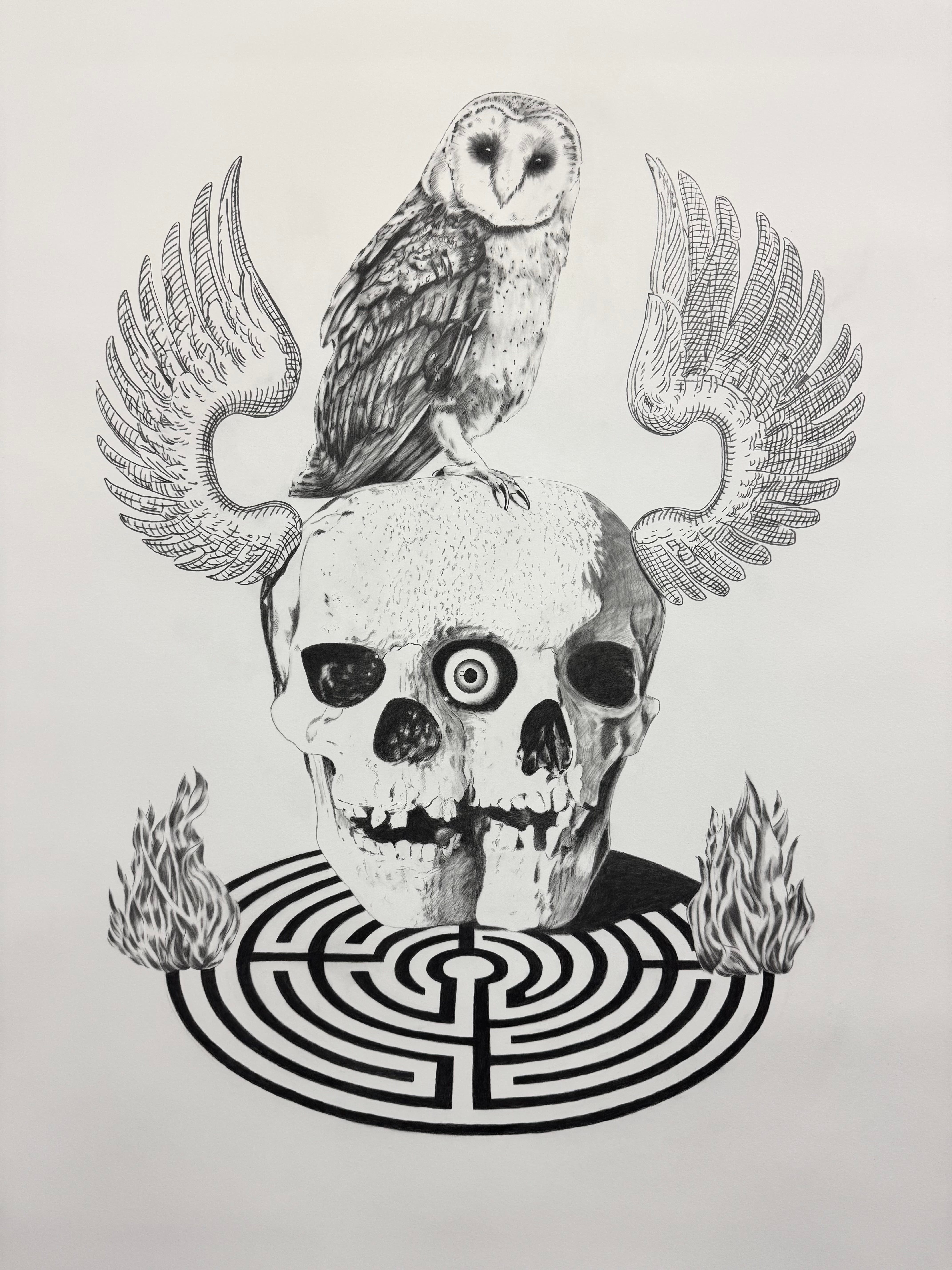
John Newsom
Esoterika, 2026
Pencil on paper
60 x 44 inches

Pre-ordered.
It’s hard to overstate the impact of your writing on my creative process (i.e. my life) over these last few months, Mitch. June 16th can’t come soon enough.
This work is needed. Salute Mitch!