

Occultism, Evil, and Curses
do cursing spells have a place in occult practice? those seeking pat answers, enter not here

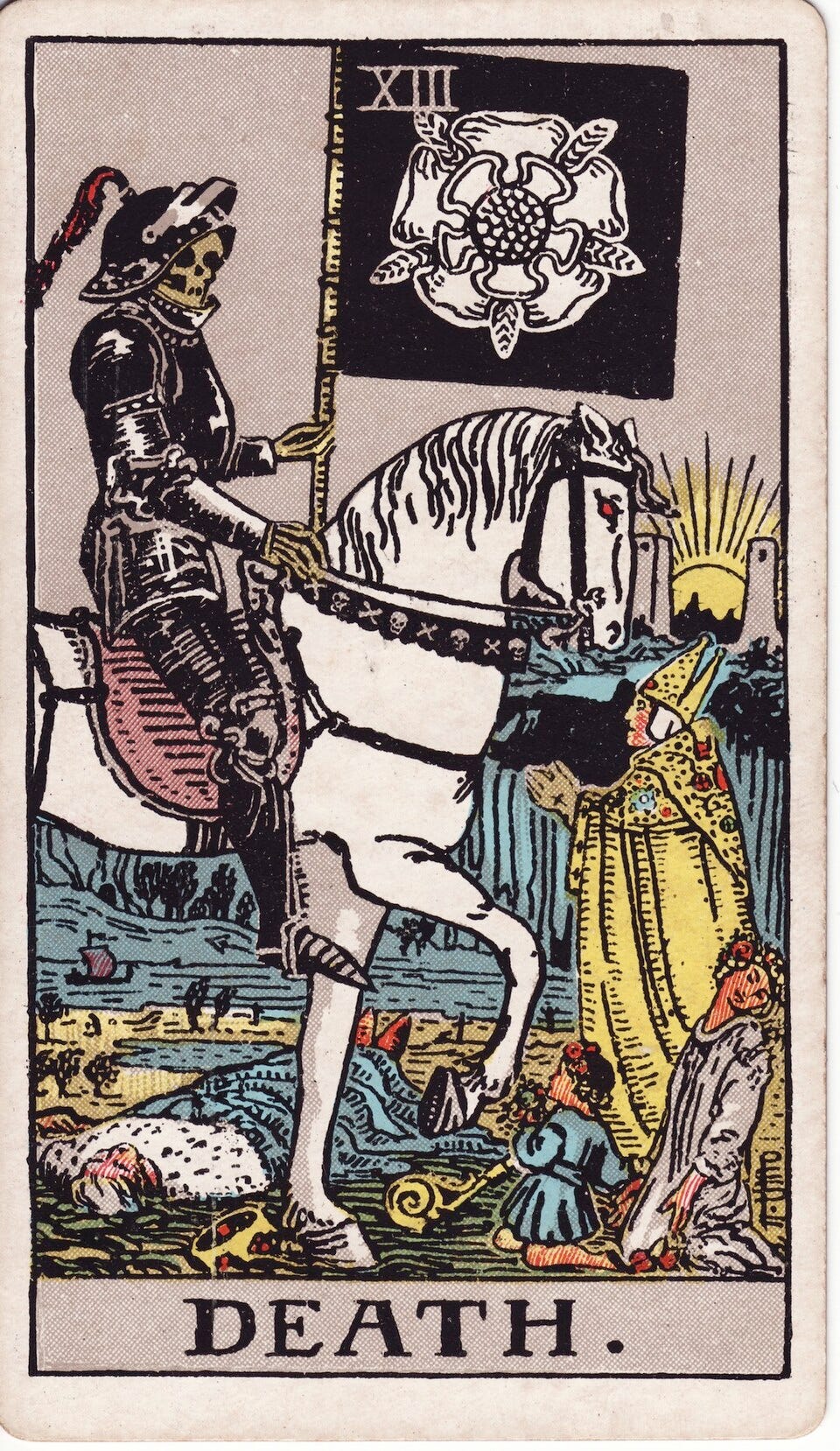
There is no confluence of evil and occultism.
Evil is the polarity of ethics furthest from empathy. It exists in the human psyche. And in mobs or mob mentalities—which are not human. They are mechanical.
Evil manifests through spite or pleasure derived from witnessing or inflicting pain. It rejects debt, broadly defined.
Evil exists too, in direct indifference to suffering. I write direct because none of us can claim full awareness or sensitivity toward suffering—hence, we are all in debt. This indifference appears in both individuals and institutions, such as systematized coding procedures used by health insurers to deny treatment.
Evil dwells in cubicles—or rather those who mandate behavior emanating from cubicles. I hesitate to blame the downstream actor. If I blame any actor, let it be me. I have not lately looked at the health-insurer stocks sitting in my index fund. Let me be judged by it.
If you wish to study evil, and cannot bring yourself to look within, look at institutions like that just referenced—they are far closer to your daily experience than historical, mythical, or lurid examples sought in ultimacy. Such examples—like news events—are often real. But: for most of us, most of the time, their citation amounts to avoidance of the mundane evils we hourly encounter and sustain, including frivolous debasement that runs riot over digital culture.
We look to things that cleanse us by their distance.
Where evil exists, there must—by the law of polarities—coexist justice or reciprocity.
But here matters grow complicated.
Is justice, as colloquially used, any more than a mental idea? I ask because I cannot see with perspective. I cannot witness a life deformed or circumstances that degrade personal helplessness or loneliness into coarse emotion, or lack of empathy, conditions which I believe some beings temperamentally enter this world with.
Nor can I witness the arc of restitution, which may be impossibly long, complex, and varied. That arc—not my self-perceived wound or objection—is justice. In this, I describe the classical karmic viewpoint found in most Vedic philosophy, and ably echoed in the work of Nietzsche. The Idealist master writes in Beyond Good and Evil in 1886: “One has to repay good and ill—but why precisely to the person who has done us good or ill?” (Walter Kaufmann trans., 1966)
One immediately wants to argue with Nietzsche’s indifference to the object of payment. Yet—we do not argue with good tidings unbidden or unpaid for. Karma requires consistency. And sometimes fearful symmetry.
Given what I have written, is the individual paralyzed to act in the direction of restitution—not so much to judge but to measure?
I cannot strip the sensitive being of that rare agency. Or its justice.
